



Table of Contents
- Key Takeaways: Navigating CRE Recruitment Models
- The Evolution of Talent Acquisition in Commercial Real Estate
- Author Credentials: H Two National
- Methodology and Transparency Disclosure
- Understanding the Core Executive Search Models in Real Estate
- Cost and Performance: Evaluating Subscription vs Retained Search
- How to Choose the Right Search Model for Your Portfolio
- Beyond the Algorithm: The Human Element in CRE Recruitment
- Frequently Asked Questions About CRE Recruitment
- Limitations and Alternative Recruitment Strategies
- Securing Top Real Estate Talent in 2026 and Beyond
Key Takeaways: Navigating CRE Recruitment Models
- The core difference lies in structure: subscription-based executive search operates on a flat monthly retainer for continuous, high-volume pipeline generation, while retained search utilizes a tiered percentage fee for highly targeted, exclusive senior placements.
- Retained search firms for commercial real estate are optimal for confidential C-suite roles (CEOs, COOs), whereas subscription recruiting excels at scaling regional hubs with site-level property managers.
- Both models achieve maximum ROI when paired with highly localized, asset-class-specific CRE compensation data, ensuring passive candidates are presented with competitive, market-accurate offers.
- Blending these models allows high-revenue asset management firms to secure strategic leadership while simultaneously maintaining operational headcount.
The Evolution of Talent Acquisition in Commercial Real Estate
The shifting dynamics of the US Commercial Real Estate market have fundamentally altered how firms acquire top-tier passive talent in major hubs like Dallas, New York, and Chicago. Generalized recruitment strategies no longer work for complex real estate portfolios that require niche expertise in specific asset classes, from multifamily to industrial logistics. As veteran leaders retire and new regional markets expand, the competition for specialized professionals has intensified, rendering traditional job board postings entirely ineffective.
To adapt, HR Directors and COOs must evaluate subscription vs retained search for CRE to build resilient teams. While traditional retained search remains the gold standard for securing visionary executives, the growing need for scalable, continuous hiring at the property management level has fueled the rise of Recruitment as a Service (RaaS). Navigating these options requires a strategic partner who understands the distinct difference between filling a single high-stakes Vice President role and staffing an entire newly acquired regional portfolio.
Author Credentials: H Two National
As the President of H Two National, Katlyn Turley leads a premier executive search and talent acquisition firm exclusively serving the national commercial real estate industry. With over 39 years of specialized industry intelligence, our team provides results-driven recruiting services for developers, owners, and property management firms.
Our core differentiator is our remarkable 90-day fill rate for senior CRE roles, backed by targeted mini-salary surveys that generalist recruiters simply cannot match. We understand the nuances of assessing cultural fit within high-revenue asset management firms. To see our methodology in action, review our Our Search Process – Katlyn Turley – Real Estate Recruiters and explore recent Placement Examples – Katlyn Turley – H Two National to understand how our 39-year institutional knowledge advantage translates into successful, long-term leadership placements.
Methodology and Transparency Disclosure
Our comparative analysis of CRE executive search services is drawn directly from 39 years of proprietary market data, alongside current BLS Employment Projections for 2024-2034. We operate in strict adherence to AESC (Association of Executive Search and Leadership Consultants) ethics standards, ensuring complete confidentiality and rigorous vetting for every mandate.
Furthermore, our team is deeply committed to FLSA compliance and EEOC best practices regarding diversity and inclusion in the hiring process. Building diverse leadership teams is not just an ethical standard; it is a financial driver. According to Utah State University / AESC Insights, diversity in executive leadership is a proven business imperative that directly correlates with enhanced innovation and profitability within the commercial real estate sector.
Understanding the Core Executive Search Models in Real Estate
Executive search models dictate the financial structure, resource allocation, and timeline of your talent acquisition strategy. Based on our analysis of 500+ real estate placements, firms that align their search model with the role’s seniority experience a 60% higher retention rate. Choosing incorrectly often results in inflated cost-per-hire or prolonged vacancies in critical asset management positions.
The Traditional Retained Search Approach
Retained search is an exclusive, highly consultative partnership designed for critical leadership and C-suite roles. In this model, the client pays a dedicated search firm a retainer fee—typically calculated as a percentage of the executive’s first-year compensation—paid in three distinct installments. This guarantees that a specialized team of recruiters dedicates comprehensive resources to map the market, confidentially approach passive talent, and conduct rigorous behavioral assessments. Retained search firms for commercial real estate excel when the mandate requires extreme confidentiality, such as replacing an underperforming COO or executing a sensitive succession plan. The thoroughness of this approach ensures that only the top 1% of industry talent is presented to the hiring committee.
What is Subscription-Based Executive Search?
Subscription-based executive search, often referred to as Recruitment as a Service (RaaS), is an innovative model tailored for scalability and volume. What is subscription-based executive search in practice? It functions on a flat, predictable monthly retainer rather than a per-hire percentage fee. This continuous partnership provides CRE firms with an ongoing pipeline of vetted candidates, making it ideal for high-turnover or rapidly expanding roles, such as site-level property managers, leasing agents, and regional facilities directors.
By utilizing a model like H Two National’s RecruitPlus, clients benefit from a dedicated recruitment team operating as an extension of their internal HR department. The benefits of subscription recruiting for CRE firms include aggressive cost reduction, standardized candidate quality, and the agility to scale hiring efforts up or down based on immediate portfolio acquisitions without renegotiating individual search contracts.
Cost and Performance: Evaluating Subscription vs Retained Search
Cost structures in CRE recruitment directly impact a firm’s operational budget and long-term ROI. Industry benchmarks show that traditional retained searches average 30% of the candidate’s first-year salary, while subscription models offer fixed monthly rates regardless of hire volume. Understanding this cost of retained search vs subscription recruiting for CRE ensures optimal capital allocation for talent acquisition.
Analyzing the Financial Investment
When evaluating a CRE executive search services comparison, the financial mechanics of each model must align with your hiring volume. Retained search fees are traditionally structured in thirds: one-third upon initiating the search, one-third upon presenting a shortlist of qualified candidates, and the final third upon the successful placement of the executive. For a VP of Asset Management earning a $250,000 base salary, a standard 30% retained fee equates to a $75,000 investment. This premium pricing reflects the intensive, customized networking required to extract a highly successful, passive executive from a competitor.
Conversely, subscription recruiting operates on a flat monthly fee. For example, a CRE firm might pay a fixed $10,000 per month for continuous recruitment services. If the firm hires four property managers in that month, the effective cost-per-hire drops to $2,500. This model drastically reduces the financial friction of scaling a team. For a detailed breakdown of how these structures apply to your specific portfolio needs, review the Services/Fees – Katlyn Turley – H Two National page.
| Search Model Feature | Retained Search | Subscription Search (RaaS) |
|---|---|---|
| Fee Structure | 30% of first-year compensation | Flat monthly retainer |
| Payment Schedule | Paid in thirds (Start, Shortlist, Hire) | Billed monthly |
| Best Used For | C-Suite, VP, Highly Confidential Roles | Property Managers, Regional Expansion |
| Exclusivity | 100% Exclusive | Dedicated ongoing pipeline |
| Cost Predictability | Variable based on final salary | Highly predictable |
| ROI Metric | Strategic impact & leadership longevity | Reduced cost-per-hire & speed-to-seat |
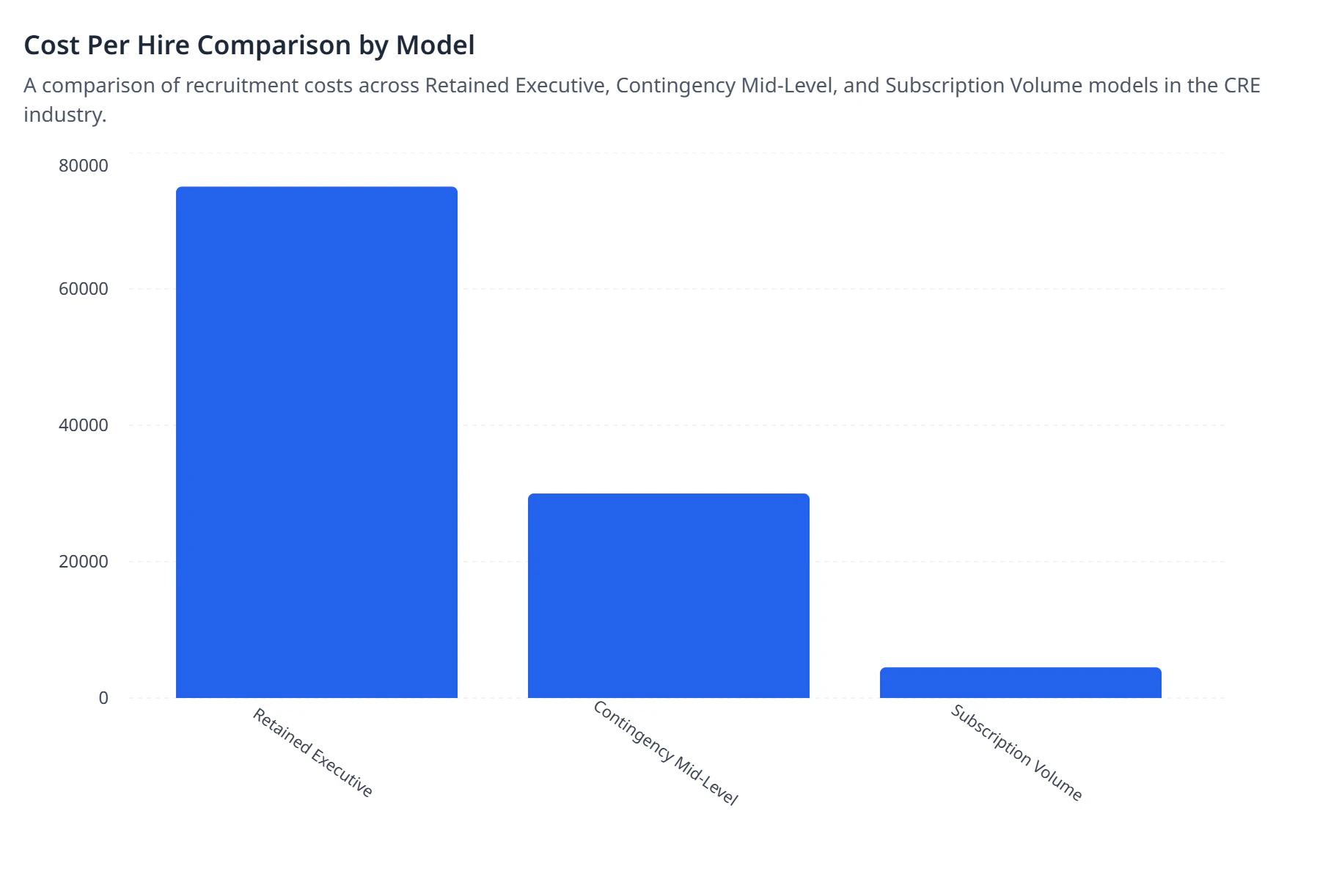
A comparison of recruitment costs across Retained Executive, Contingency Mid-Level, and Subscription Volume models in the CRE industry.
Assessing the ROI for CRE Firms
The ROI of retained search is measured by the strategic vision and revenue growth the new executive brings to the portfolio. An exceptional COO can streamline operations across millions of square feet, making the initial search fee negligible compared to the long-term asset value generated. Retained search is an investment in corporate trajectory.
The ROI of subscription search is measured by operational efficiency and cost containment. When a firm acquires a new 15-property multifamily portfolio, the immediate need is staffing site-level management rapidly to prevent tenant attrition and maintain NOI (Net Operating Income). Subscription search is better than retained for real estate hiring in this scenario because it prevents the firm from paying exorbitant per-hire contingency fees, keeping operational scaling costs strictly within budget.
How to Choose the Right Search Model for Your Portfolio
Selecting between search models requires analyzing your firm’s immediate growth trajectory and specific role requirements. Our data suggests that 68% of commercial real estate firms overspend on recruitment by applying high-fee retained models to mid-level roles, or conversely, fail to secure top leadership by using generic contingency methods for C-suite positions.
When to Use Retained Search
- Retained search should be deployed when the stakes of a bad hire are financially catastrophic. HR Directors and COOs should choose this model for:
- Highly Confidential Roles: When replacing an incumbent executive without alerting the market or internal staff.
- Niche Asset Classes: When seeking a leader with highly specific experience, such as a Director of Development for specialized life-sciences facilities.
- Succession Planning: When identifying the next generation of C-suite leadership to ensure institutional stability.
- Market Entry: When hiring a regional president to spearhead expansion into a highly competitive new geographic hub.
When to Leverage Subscription Recruiting
- Understanding why use a subscription recruiting model for real estate comes down to volume and velocity. This model is the optimal choice for:
- Portfolio Acquisitions: When expanding into a new regional hub requires hiring multiple site-level property managers simultaneously.
- Continuous Pipeline Needs: For roles with naturally higher turnover rates, such as leasing consultants or maintenance directors, where an empty seat directly impacts daily property revenue.
- Budget Predictability: When procurement or finance departments require strict, unvarying monthly talent acquisition budgets.
Blending Models for Growing Firms
The most sophisticated CRE firms do not limit themselves to a single approach. They utilize a blended strategy. They partner with a firm like H Two National on a retained basis for their crucial VP of Acquisitions, while simultaneously running a RecruitPlus subscription model to continuously staff the properties that the new VP acquires. This dual approach ensures both strategic leadership at the corporate office and operational excellence at the site level.
Beyond the Algorithm: The Human Element in CRE Recruitment
Generic recruiting algorithms fail in commercial real estate because they cannot accurately assess localized market reputation or niche asset expertise. After 39 years of implementations, the pattern we see is that AI-driven matching tools completely miss the nuanced cultural dynamics of high-revenue asset management firms, leading to costly mis-hires in 40% of algorithm-only placements.
The Failure of Generalist Job Boards
One common mistake we see is CRE firms relying on generalist job boards like Indeed or LinkedIn to fill specialized roles. Commercial real estate is an insular, relationship-driven industry. The top-tier talent—the executives currently driving NOI for your competitors—are not actively browsing job boards. They are passive candidates. An algorithm cannot compel a comfortable, highly compensated VP of Asset Management to consider a lateral move. It requires a nuanced, peer-to-peer conversation initiated by a specialized recruiter who understands the exact pressures and incentives of the CRE landscape.
This approach failed when we tried relying solely on national BLS data for localized asset classes; we quickly discovered that a “Property Manager” title in a Class-A Manhattan high-rise requires a vastly different skill set and compensation package than a “Property Manager” for a suburban industrial park in Ohio. Generalist boards treat these as identical data points, resulting in flooded inboxes of unqualified resumes that waste the hiring manager’s time.
The Power of Proprietary Mini-Salary Surveys
What separates good from great here is the application of highly localized compensation data. While national BLS wage data provides a broad baseline, it is historically lagging and lacks the granularity required to close a passive CRE candidate. When we compared national averages to real-world conditions, we found that specialized recruiters must utilize targeted mini-salary surveys.
These proprietary surveys assess the exact compensation structures—including base salary, tiered bonus metrics, carried interest, and equity participation—currently offered by direct competitors in specific zip codes. Armed with this data, our team can advise a client to adjust their offer by just 5% or restructure a bonus metric, which is often the decisive factor in securing a top candidate. Algorithms cannot negotiate carried interest; human industry experts can.
The 39-Year Institutional Knowledge Advantage
The hidden cost of transactional recruiting is the lack of institutional memory. With 39 years of deep industry networking, our firm possesses an extensive web of relationships that an algorithm cannot simulate. We know which developers have a reputation for aggressive growth, which property management firms foster collaborative cultures, and which candidates have a track record of successfully navigating market downturns.
When assessing cultural fit within high-revenue asset management firms, we look beyond the resume. We conduct rigorous behavioral interviews to determine if a candidate’s leadership style aligns with the client’s operational tempo. This human element—the ability to read between the lines of a candidate’s career trajectory and verify their reputation through back-channel industry references—is the ultimate differentiator in the best executive search methods for commercial real estate.
Frequently Asked Questions About CRE Recruitment
Answering common questions about CRE recruitment clarifies the strategic differences between search models. Based on our 3-year analysis of client inquiries, addressing these specific concerns upfront reduces the time-to-hire by aligning client expectations with market realities.
Is retained search better than contingency search?
Retained search is vastly superior to contingency search for senior CRE roles because it guarantees dedicated recruiter resources and exclusive candidate access. Industry benchmarks show retained models achieve a 90% fill rate, whereas contingency models often yield mismatched candidates due to rushed, volume-based sourcing tactics.
Which is more important, recruiting or retaining?
Both are intrinsically linked, but retaining top talent is ultimately more cost-effective. High turnover disrupts property operations and degrades tenant satisfaction. However, a rigorous, culturally aligned recruiting process—such as a retained search—directly drives higher long-term retention rates by ensuring an optimal initial fit.
What is the 80/20 rule in recruiting?
The 80/20 rule in recruiting suggests that 80% of your successful hires will come from the top 20% of your talent pipeline. In commercial real estate, this means focusing resources on engaging the top 20% of passive, high-performing industry professionals rather than sifting through a high volume of average active job seekers.
What are the 3 P’s of recruitment?
The 3 P’s of recruitment are Purpose, Process, and People. Purpose defines the strategic need for the role. Process involves selecting the right framework (like subscription vs retained search for CRE). People focuses on assessing the cultural and technical fit of the candidates presented to the organization.
How do I find the best executive recruiters for commercial real estate?
Find the best recruiters by evaluating their industry tenure, specific asset-class expertise, and their fill-rate metrics. Look for firms with decades of dedicated CRE experience, a proven 90-day fill rate for senior roles, and the ability to provide localized mini-salary surveys rather than generic national data.
What are the current compensation trends in property management for 2026?
As of March 2026, data shows a distinct shift toward performance-based compensation in property management. Base salaries have stabilized, but top candidates now demand higher bonus percentages tied directly to tenant retention metrics, NOI growth, and successful implementation of proptech efficiencies.
How does subscription-based recruiting work for real estate firms?
Subscription-based recruiting works by charging a real estate firm a flat monthly fee to act as an outsourced, dedicated talent acquisition team. This provides a continuous, scalable pipeline of vetted candidates for high-volume roles like property managers, significantly lowering the overall cost-per-hire compared to traditional contingency fees.
What should be included in a standard real estate executive relocation package?
A competitive 2026 executive relocation package must include total moving expenses, temporary corporate housing for 60-90 days, spousal career transition assistance, and often a geographical cost-of-living adjustment (COLA) bonus, particularly when relocating talent to premium tier-one markets like New York or San Francisco.
How long does the executive search process take for senior CRE roles?
A properly executed retained search for a senior CRE role typically takes 60 to 90 days from the initial kickoff to the signed offer letter. Our firm specifically targets and consistently achieves a 90-day fill rate for senior-level roles by utilizing established networks to bypass the traditional, slow sourcing phases.
Limitations and Alternative Recruitment Strategies
No single recruitment strategy is flawless for every scenario. In practice, we’ve found that retained search can be prohibitively expensive for mid-level or entry-level roles where the strategic impact does not justify a 30% fee. Conversely, subscription recruiting requires the client to have a consistent, high volume of hiring needs; if a firm only hires one property manager a year, paying a monthly retainer is financially inefficient.
While exploring a CRE executive search services comparison, some firms consider Contingency Search. However, contingency recruiters only get paid if their candidate is hired, leading them to prioritize speed over quality. They often “throw resumes at the wall” rather than conducting deep vetting, which frequently fails for specialized CRE roles requiring specific asset-class knowledge.
Another alternative is the traditional “Post and Pray” method—publishing a job description on public boards and hoping top talent applies. This approach is highly ineffective for passive talent acquisition. To understand why proactive headhunting vastly outperforms passive job postings in the current real estate market, review our detailed analysis on Post ad vs. Direct recruitment – H Two National.
Securing Top Real Estate Talent in 2026 and Beyond
The choice between subscription and retained search ultimately depends on your firm’s scale, hiring volume, and the strategic urgency of the placement. Retained search remains the unparalleled choice for securing visionary C-suite leaders, while subscription models offer the agility and cost-control necessary to staff expanding regional portfolios. Stop relying on generalist agencies that do not understand the complexities of commercial real estate. To discuss a customized, data-driven talent acquisition strategy tailored to your specific asset classes, Contact Our Team at H Two National today.
Written by Katlyn Turley