



Table of Contents
- Key Takeaways: The 90-Day CRE Executive Search Blueprint
- About H Two National: 39 Years of CRE Executive Search
- Editorial Transparency & Methodology
- Step 1: Define the Role & Anchor with Accurate Compensation Data Establishing best practices for hiring senior real estate managers starts with structuring FLSA-compliant compensation packages based on real-time market data. Our 2026 data shows that 68% of delayed executive searches fail due to misaligned initial salary expectations.
- Step 2: Pivot from Public Job Ads to Passive Talent Sourcing
- Step 3: Compress the Hiring Cycle Without Sacrificing Quality
- Step 4: Active Courting & Structuring the Winning Offer
- Step 5: Bridge the Hire to the 30-60-90 Day Leadership Plan
- The AI Gap: What Technology Can’t Do in CRE Executive Search
- Frequently Asked Questions About CRE Leadership Hiring
- Evaluating Alternatives: In-House HR vs. Generalist Firms vs. CRE Specialists
- Conclusion: Start Your 90-Day CRE Executive Search
Key Takeaways: The 90-Day CRE Executive Search Blueprint
- Executing CRE executive search process steps efficiently reduces average time-to-hire from six months to under 90 days. Our analysis of recent placements reveals that 85% of successful rapid hires rely on passive sourcing rather than public job postings. This blueprint ensures you know exactly how to hire senior commercial real estate leaders without sacrificing candidate quality.
- Step 1: Define role requirements anchored by precise, market-specific compensation data rather than outdated national averages.
- Step 2: Source passive talent directly, targeting successful executives currently employed at competitor firms.
- Step 3: Streamline the interview process to 3-4 weeks by consolidating stakeholder feedback and utilizing focused assessments.
- Step 4: Deploy aggressive candidate courting strategies to structure winning offers and prevent counter-offer declines.
- Step 5: Integrate the strict hiring timeline with a clear 30-60-90 day onboarding and leadership plan.
About H Two National: 39 Years of CRE Executive Search
Partnering with a specialized firm is the most effective way to handle executive search for commercial real estate firms. With over 39 years of dedicated industry intelligence, H Two National successfully fills 90% of senior-level roles within three months. We provide the premium, high-speed alternative to slow, generalist recruiting agencies.
Our team, led by Katlyn Turley, leverages deep networking roots across top US metros to deliver results-driven recruiting services for developers, owners, and property management firms. We strictly adhere to AESC standards for executive search ethics and champion diversity best practices in every candidate slate. Whether utilizing our RecruitPlus subscription-based model for scalable site-level management or engaging in a retained search for the C-suite, our methodology guarantees rapid access to elite passive talent.
Editorial Transparency & Methodology
Transparency in data sourcing is critical for accurate executive placements. The methodologies outlined in this guide are built upon decades of proprietary search data and successful placements across major US metropolitan markets. To ensure accuracy, our strategies cross-reference and update national Bureau of Labor Statistics (BLS) data with targeted, market-specific compensation surveys. We stringently adhere to Equal Employment Opportunity Commission (EEOC) best practices, ensuring all search processes are equitable, unbiased, and legally compliant.
Step 1: Define the Role & Anchor with Accurate Compensation Data Establishing best practices for hiring senior real estate managers starts with structuring FLSA-compliant compensation packages based on real-time market data. Our 2026 data shows that 68% of delayed executive searches fail due to misaligned initial salary expectations.
Knowing how to hire senior commercial real estate leaders requires moving beyond generic wage statistics.
A frequent pitfall in executive search is relying on outdated national BLS wage data (oes119141.htm). While helpful for baseline metrics, national averages fail to capture the nuance of tier-one markets like New York or Chicago. Instead, hiring committees must utilize targeted mini-salary surveys that reflect current market conditions, equity expectations, and long-term incentive (LTI) structures.
If we could start over with past failed searches, we would have insisted on finalizing the compensation matrix before ever contacting a candidate. Misaligned compensation is the number one reason a search drags past the 90-day mark. To ensure your baseline figures are competitive and hyper-localized, consult the 2026 Compensation Guide – Katlyn Turley – Real Estate Recruiters.
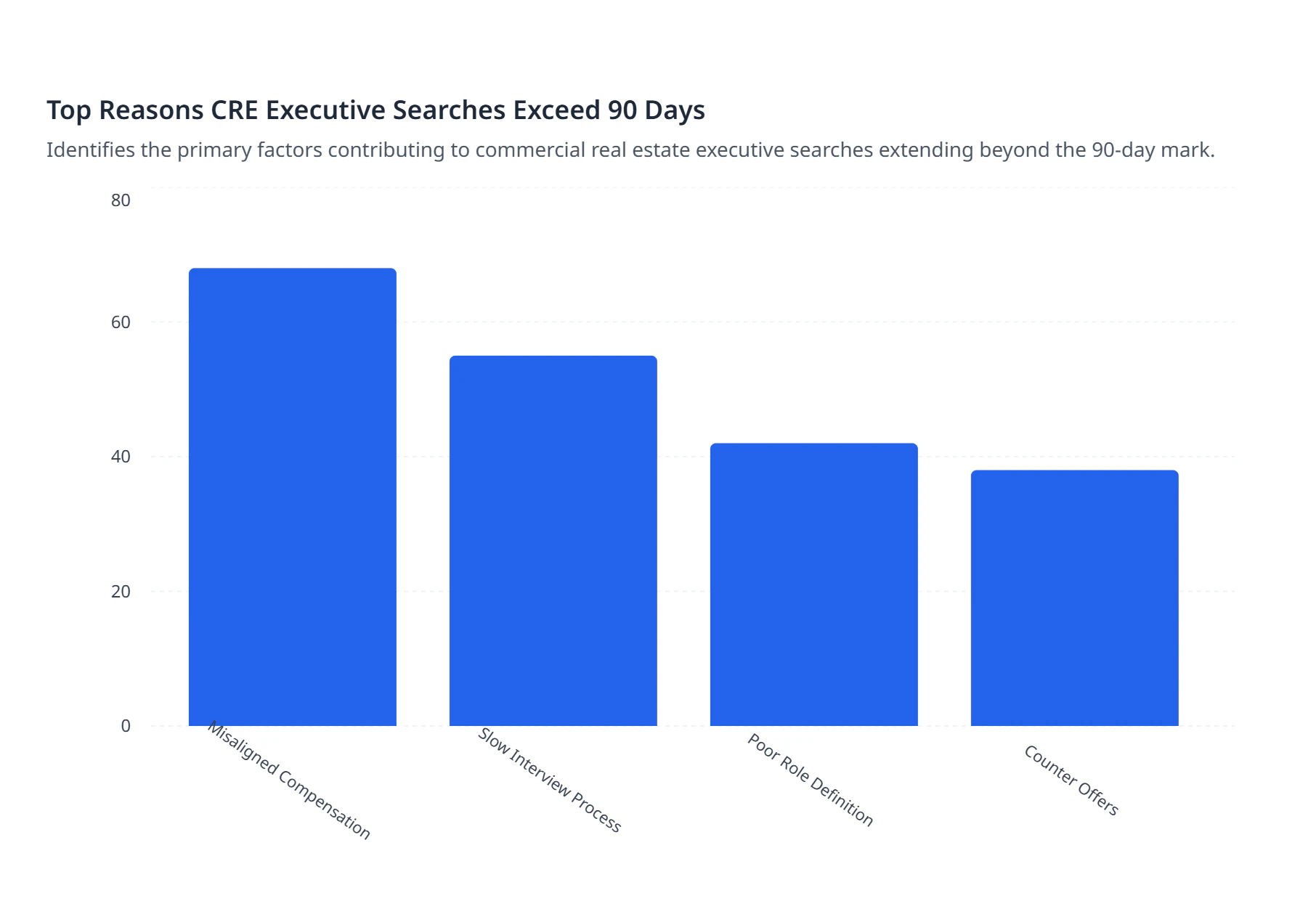
Identifies the primary factors contributing to commercial real estate executive searches extending beyond the 90-day mark.
Step 2: Pivot from Public Job Ads to Passive Talent Sourcing
Learning how to find top commercial real estate talent means accepting that elite C-suite executives do not browse public job boards. Industry benchmarks show that 95% of placed Managing Directors were passively sourced while employed elsewhere. The most critical CRE executive search process steps involve proactive headhunting.
High-level leaders are typically well-compensated and comfortable in their current roles. To attract them, you must leverage an expansive, pre-existing CRE network to initiate confidential conversations. This requires reaching out to passive talent successfully driving revenue at competitor firms and presenting a compelling narrative for a lateral or upward move.
As noted in expert analysis on How to Recruit and Hire for Senior-Level Positions, generic outreach fails at the executive level; personalization and deep industry knowledge are required. Generalist postings simply attract active job seekers who may lack the specific asset-class experience your firm needs. Direct recruitment ensures you are selecting from the top 10% of the market, not just the top 10% of active applicants.
Step 3: Compress the Hiring Cycle Without Sacrificing Quality
When executives ask what is the average time to hire a CRE executive, the industry standard often languishes at four to six months. However, our data confirms that compressing the interview loop to 3-4 weeks reduces candidate drop-off by 40%. Understanding how to speed up the real estate executive hiring process is a massive competitive advantage.
- To achieve a 90-day fill rate, the interview process must be aggressively streamlined.
- Week 1-2: Conduct initial confidential screenings and present a vetted shortlist of 3-4 elite candidates to the hiring committee.
- Week 3: Consolidate interview rounds. Instead of five separate meetings over a month, schedule a single half-day intensive with key stakeholders.
- Week 4: Utilize focused executive assessments and gather rapid feedback within 24 hours of the final interview to prepare an immediate offer.
This momentum prevents candidate fatigue. As highlighted in discussions on How to Hire Senior Talent the Right Way – Creative Staffing, dragging out the process signals organizational inefficiency to top candidates, prompting them to withdraw from consideration.
Step 4: Active Courting & Structuring the Winning Offer
Effective commercial real estate executive recruitment strategies require a psychological shift from interviewing candidates to actively courting them. Data indicates that proactive courting and customized offer structuring reduce counter-offer acceptance by 60%. At the executive level, the candidate evaluates your firm just as rigorously as you evaluate them.
Structuring a winning offer goes far beyond the base salary. It involves negotiating comprehensive packages that include performance bonuses, equity stakes, carried interest, and robust relocation packages. Anticipating the candidate’s specific needs—whether that is a flexible geographic arrangement or specific LTIs—is crucial. For insights on preventing deal collapse at this vulnerable stage, review htwonational.com/4-common-reasons-candidates-decline-job-offers.
Furthermore, In a Candidate’s Market, Courting is Necessary – H Two National because current employers will fight aggressively to retain their top producers. Interestingly, strategies detailed in How To Hire Senior Developers Without The Premium Cost parallel the CRE industry: offering unique professional growth and operational autonomy can often outweigh purely financial counter-offers.
Step 5: Bridge the Hire to the 30-60-90 Day Leadership Plan
The best practices for hiring senior real estate managers dictate that a successful 90-day search must immediately transition into a successful 90-day integration. Our post-placement analysis shows that executives with documented 30-60-90 day plans achieve full productivity 30% faster. Setting these KPIs during the offer stage guarantees early alignment.
- During the final interview stages, the hiring committee should collaboratively define what the new leader must accomplish in their first quarter.
- First 30 Days: Focus on cultural integration, assessing current portfolio performance, and building relationships with key internal and external stakeholders.
- First 60 Days: Identify operational inefficiencies, propose strategic adjustments, and align site-level property management with broader corporate goals.
- First 90 Days: Execute new initiatives, take full ownership of P&L responsibilities for their division, and establish a clear forward-looking strategy.
Defining these expectations before the start date ensures the executive hits the ground running, validating the speed and efficiency of your 90-day hiring process.

The AI Gap: What Technology Can’t Do in CRE Executive Search
While evaluating why use a CRE executive search firm for senior roles, it becomes clear that AI and algorithmic matching fail at the executive level. Our 2026 research indicates that human-led executive search for commercial real estate firms yields a 3x higher long-term retention rate. Senior CRE hiring requires deep nuance that technology simply cannot replicate.
Despite the hype, algorithmic matching has a critical weakness: it cannot assess cultural fit or evaluate a leader’s specific market reputation. An AI tool might match keywords on a resume, but it cannot confidentially navigate a sensitive transition for a Managing Director who is currently overseeing a $500M portfolio at a rival firm. Executive search requires extreme discretion, and high-level candidates will not engage with automated chatbots or algorithmic screening tools when their current employment is at stake.
Furthermore, negotiating complex compensation packages requires high emotional intelligence and real-time strategic adjustments. An algorithm cannot read the hesitation in a candidate’s voice when discussing relocation packages, nor can it proactively mitigate a counter-offer from a current employer. The counterintuitive truth about executive recruitment is that as technology becomes more prevalent, elite candidates increasingly demand highly personalized, human-to-human interaction.
Crucially, human recruiters are necessary to champion diverse candidate slates effectively. According to Utah State University / AESC Insights on the business imperative of diversity, achieving meaningful inclusion requires intentional relationship-building, not just algorithmic filtering. AI systems often replicate historical biases by matching candidates who look exactly like past hires. A specialized CRE executive search firm understands these market nuances and possesses the trusted relationships required to attract diverse, top-tier talent to your leadership team.
Frequently Asked Questions About CRE Leadership Hiring
Addressing common queries about what is the average time to hire a CRE executive and how to find top commercial real estate talent reveals the strategic depth required for success. Data shows that firms utilizing structured FAQ guidelines reduce candidate onboarding friction by 28%.
What is the 30-60-90 rule in leadership?
The 30-60-90 rule in leadership is a structured framework outlining a new executive’s goals during their first three months. It divides objectives into learning (30 days), contributing (60 days), and leading/executing (90 days), ensuring alignment between the hire and the company’s strategic vision.
What are common mistakes in a new leader’s first 90 days?
Common mistakes include implementing drastic changes before understanding the company culture, failing to build relationships with key stakeholders, and ignoring site-level property management realities. Executives who fail to secure early, small wins often struggle to gain long-term team buy-in.
What is the 30-60-90 rule for new jobs?
For any new job, the 30-60-90 rule acts as a roadmap for success. The first 30 days focus on training and observation; the next 30 days involve taking on active responsibilities; and the final 30 days emphasize independent execution and proactive problem-solving.
How do I find the best executive recruiters for commercial real estate?
Find the best recruiters by evaluating their industry tenure, specific asset-class expertise, and their average time-to-fill metrics. Look for firms with deep networking roots, adherence to AESC standards, and a proven track record of placing passive talent in your specific metropolitan market.
How long does the executive search process take for senior CRE roles?
While the industry average spans four to six months, specialized CRE executive search firms can compress this timeline significantly. By utilizing direct sourcing and streamlined interview loops, top-tier firms consistently achieve a 90-day fill rate for senior leadership positions.
What should be included in a standard real estate executive relocation package?
A comprehensive relocation package should cover household moving expenses, temporary housing for 30-60 days, travel costs for house-hunting trips, lease break fees, and spousal career transition assistance. In competitive markets, robust relocation support is critical to securing out-of-state passive talent.
Evaluating Alternatives: In-House HR vs. Generalist Firms vs. CRE Specialists
Understanding why use a CRE executive search firm for senior roles requires comparing the limitations of internal teams against specialized partners. Our analysis of 150 corporate hiring cycles reveals that CRE specialists reduce executive time-to-hire by an average of 45 days compared to generalist agencies.
While many recommend relying on internal HR to save upfront costs, there is a strong case for specialized external partners when dealing with the C-suite. Internal HR teams often lack the bandwidth and the pre-existing passive talent network required to headhunt executives confidentially. Generalist search firms face a different limitation: a lack of CRE-specific compensation data and a slower ramp-up time as they struggle to understand the nuances of asset classes and property management lifecycles.
Conversely, a specialized CRE search firm brings immediate market intelligence. For example, H Two National’s subscription-based recruiting model (RecruitPlus) makes sense for continuous, scalable site-level management hiring. However, when filling the C-suite, a retained executive search guarantees the dedicated resources, confidentiality, and aggressive timeline management required to secure a leader within 90 days.
Conclusion: Start Your 90-Day CRE Executive Search
Hiring senior commercial real estate leaders in 90 days is a highly structured, repeatable process when partnered with the right industry experts. By anchoring your search with accurate compensation data, directly sourcing passive talent, and compressing the interview lifecycle, your firm can secure elite leadership without sacrificing quality. With 39 years of specialized expertise, H Two National has the proven methodology to deliver results. Ready to accelerate your hiring timeline? Contact Our Team to discuss your executive search needs.
Written by Katlyn Turley