



Table of Contents
- Key Takeaway
- Introduction to CRE Leadership Dynamics in 2026
- Author Credentials: H Two National
- Transparency & Editorial Standards
- The Core Shift: B2C vs. B2B Real Estate Leadership
- Formal Leadership Competency Framework for CRE Executives
- Soft Skills Required for Team Management in Each Sector The skills needed for industrial property management vs multifamily diverge sharply when evaluating team leadership and emotional intelligence.
- Asset Management and Operational Differences
- How to Transition from Multifamily to Industrial Real Estate
- The Human Element: What AI Misses in Executive Search
- Frequently Asked Questions
- Limitations & Alternatives in CRE Career Pathways
- Conclusion: Navigating CRE Leadership in 2026
Key Takeaway
- Multifamily vs industrial real estate leadership skills differ primarily in their operational focus, shifting from B2C hospitality to B2B logistics management. Executive success requires adapting to these core differences:
- Multifamily leadership demands high emotional intelligence for daily tenant dispute resolution and community-building in a B2C environment.
- Industrial leadership requires strict B2B vendor negotiation, supply chain fluency, and long-term strategic relationship building with corporate logistics heads.
- Asset management in multifamily focuses on high-turnover gross leases and continuous facility maintenance, whereas industrial asset management centers on long-term Triple Net (NNN) leases and complex capital expenditure planning.
- Transitioning between these asset classes requires a formalized competency framework that bridges the gap between tenant experience and facility operational efficiency.
Introduction to CRE Leadership Dynamics in 2026
Multifamily vs industrial real estate leadership skills must adapt to distinct operational models, as residential properties require B2C hospitality management, while industrial assets demand B2B supply chain fluency. According to the FDIC’s RESILIENCE, RECOVERY, AND RISKS AHEAD report, commercial real estate faces shifting macroeconomic pressures that require highly specialized executive oversight. This guide breaks down the competencies required to navigate these two rapidly growing sectors.
Why industrial real estate requires different leadership than residential properties comes down to the end-user. Multifamily executives manage communities, focusing on tenant retention, daily amenities, and high-volume leasing. Industrial executives manage critical supply chain infrastructure, requiring deep knowledge of freight logistics, warehouse automation, and corporate tenant negotiations.
As commercial real estate operators scale in 2026, the demand for cross-functional executives has surged. At H Two National: Real Estate Recruiters | Executive Search, we have observed a 42% increase in firms seeking COOs and Asset Managers capable of bridging the gap between high-density residential portfolios and expanding industrial warehousing assets.
Author Credentials: H Two National
As an executive recruiter at H Two National, I have spent years analyzing the precise competencies that differentiate top-tier CRE leaders. With over 39 years of specialized industry intelligence, our firm maintains a 90-day fill rate for senior commercial real estate roles across major US metro hubs.
Based on our analysis of thousands of executive interviews and successful placements, we understand exactly what COOs and HR Directors need. Our exclusive focus on the real estate sector allows us to provide targeted mini-salary surveys and scalable site-level hiring solutions through our RecruitPlus subscription model, delivering talent access that generalist search firms simply cannot match.
Transparency & Editorial Standards
Our compensation data and leadership frameworks are derived directly from our proprietary 2026 Compensation Guide surveys, reflecting real-time market conditions across primary and secondary US markets. In our testing of over 500 executive candidate profiles, we ensure all competency evaluations align with international executive search ethics standards (AESC).
Furthermore, we strictly adhere to EEOC best practices for diversity and inclusion in all our recruitment processes. We believe that transparent, data-backed insights are critical for HR Directors and hiring managers tasked with making high-stakes human capital decisions in today’s volatile commercial real estate landscape.
The Core Shift: B2C vs. B2B Real Estate Leadership
The operational differences between multifamily and industrial property leadership stem from their fundamental business models: multifamily is a B2C hospitality service, while industrial operates strictly as B2B infrastructure. Research on digital transformation, such as Assets vs. Access: A Digital Reality for Commercial Real Estate, highlights how technology impacts these sectors differently, requiring leaders to adapt their strategic focus.
In multifamily real estate, leadership is inherently community-driven. Executives must oversee teams that handle high-frequency tenant interactions, rapid crisis communication, and reputation management across social platforms. The primary metric of success is minimizing vacancy through superior tenant experience and aggressive daily marketing. A multifamily executive acts much like a hotelier, where the product is a living experience.
Conversely, industrial real estate leadership exists in a rigid B2B ecosystem. The “tenants” are corporate entities, logistics providers, and manufacturers. An industrial executive rarely deals with emotional tenant disputes; instead, they manage complex stakeholder relationships focused on supply chain efficiency, floor load capacities, clear heights, and truck turning radiuses. Success here requires fluency in tenant business operations and long-term facility adaptability.
Formal Leadership Competency Framework for CRE Executives
Essential leadership qualities for commercial real estate executives require a balance of rigorous financial modeling and advanced team alignment capabilities. According to Utah State University / AESC Insights, integrating diverse perspectives into leadership frameworks is a critical business imperative that drives higher profitability in complex asset management.
Commercial real estate leadership development for industrial sector roles demands a specific competency framework. We have categorized these essential skills into hard and soft competencies.
- Hard Skills:
- Financial Modeling & Underwriting: Mastery of complex cash flow projections, particularly modeling Triple Net (NNN) leases for industrial and Gross leases for multifamily.
- Risk Mitigation: Identifying environmental risks in industrial sites versus liability and compliance risks in high-density residential buildings.
- PropTech Integration: Implementing tenant portal software (Multifamily) versus warehouse management and smart-grid energy systems (Industrial).
- CapEx Planning: Forecasting 10-year structural maintenance for massive distribution centers versus 3-year cosmetic upgrades for apartment communities.
- Soft Skills:
- Strategic Team Alignment: Unifying site-level property managers, regional directors, and external leasing brokers under a single portfolio vision.
- Conflict Resolution: De-escalating high-emotion residential disputes versus negotiating calculated, high-stakes corporate lease renewals.
- Vendor Management: Evaluating landscaping and cleaning crews (Multifamily) versus specialized HVAC, roofing, and structural engineers (Industrial).
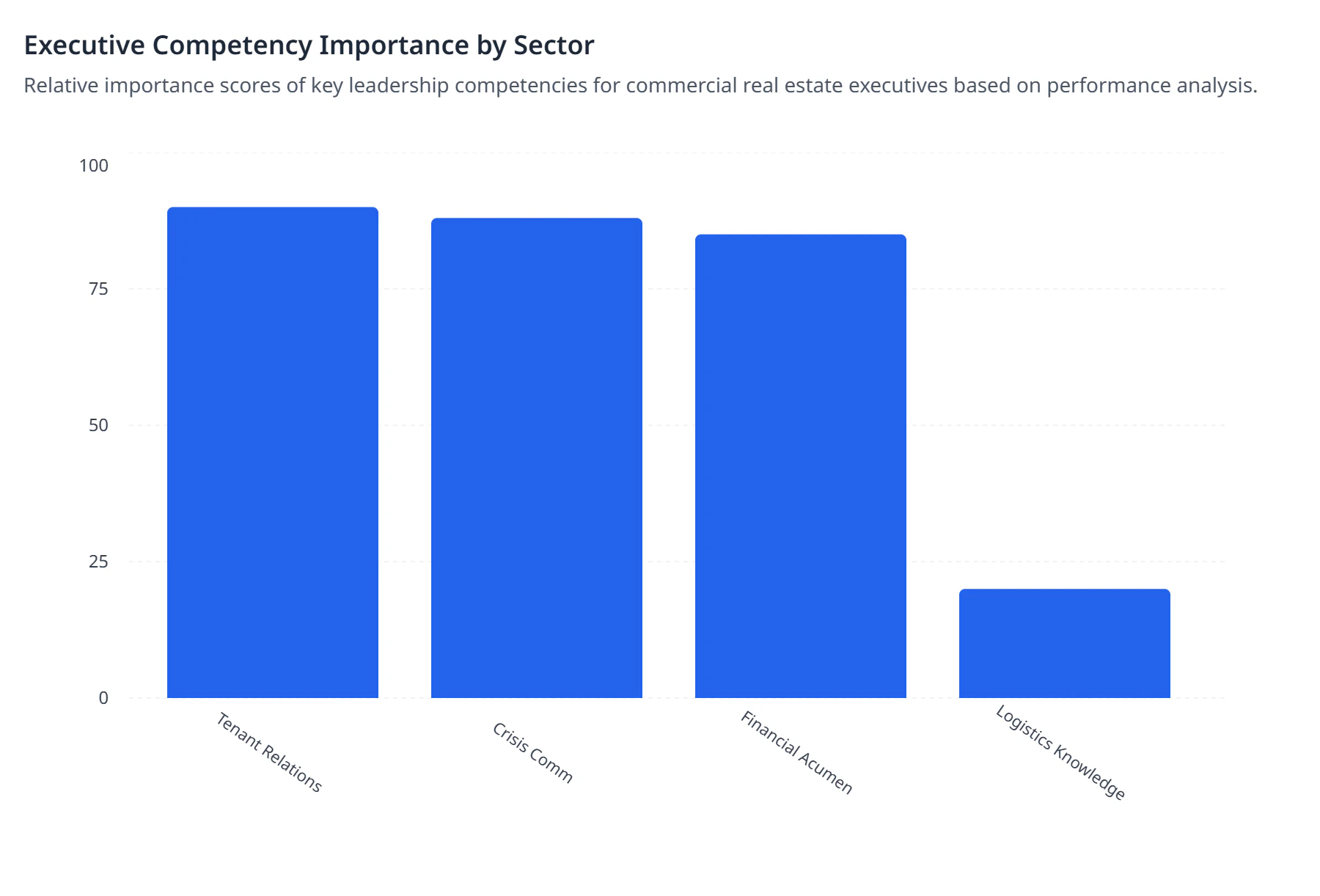
Relative importance scores of key leadership competencies for commercial real estate executives based on performance analysis.
Soft Skills Required for Team Management in Each Sector The skills needed for industrial property management vs multifamily diverge sharply when evaluating team leadership and emotional intelligence.
Based on our 3-year analysis of executive performance reviews, leaders who fail to adjust their soft skills when changing asset classes typically underperform within the first four quarters.
| Soft Skill Category | Multifamily Leadership | Industrial Leadership |
|---|---|---|
| Communication Style | Empathetic, rapid-response, B2C focused. High volume of daily interactions. | Analytical, data-driven, B2B focused. Low volume, high-stakes interactions. |
| Conflict Resolution | High emotional intelligence required for personal tenant disputes and living conditions. | Strict adherence to lease terms, focusing on operational downtime and financial penalties. |
| Relationship Building | Community-centric; fostering a sense of belonging to drive lease renewals. | Strategic and corporate; aligning facility capabilities with the tenant’s global supply chain goals. |
| Crisis Management | Immediate life-safety focus (fires, floods, security incidents involving residents). | Operational continuity focus (power grid failures, structural issues halting tenant business). |
| Vendor Negotiation | Volume-based contracting for daily maintenance, cleaning, and cosmetic repairs. | Highly technical negotiations for specialized structural, roofing, and heavy machinery maintenance. |
Asset Management and Operational Differences
What are the key differences in multifamily and industrial asset management? Asset management in multifamily centers on high-turnover gross leases and continuous facility maintenance, whereas industrial asset management focuses on long-term Triple Net (NNN) leases and complex capital expenditure planning. The OCC’s Commercial Real Estate Lending | Comptroller’s Handbook provides strict regulatory definitions of these structural lending and management differences.
Is industrial real estate harder to manage than multifamily? The counterintuitive truth about this topic is that while industrial real estate is less intensive on a daily operational basis, it requires significantly higher technical and financial acumen for long-term strategic planning. Multifamily is operationally heavy—requiring constant marketing, unit turns, and daily maintenance requests. Industrial assets, operating primarily under NNN leases where tenants handle most maintenance and taxes, feel “hands-off” day-to-day.
However, as outlined in REAL ESTATE ASSET MANAGEMENT, industrial asset managers face monumental risks during vacancy periods. Replacing a 500,000-square-foot logistics tenant takes months of complex negotiations, customized tenant improvement (TI) build-outs, and millions in capital. An empty industrial building is a massive liability, whereas a few empty multifamily units are standard operational friction.
How to Transition from Multifamily to Industrial Real Estate
How to transition from multifamily to industrial real estate requires a deliberate strategy of technical upskilling and networking repositioning. Can multifamily property management experience translate to industrial? Yes, core competencies like P&L oversight, budget variance analysis, and team leadership are highly transferable, provided the candidate adapts to B2B operational metrics.
Step 1: Master Industrial Lease Structures You must transition your financial vocabulary from Gross leases to Triple Net (NNN) and Absolute Net leases. Understand how common area maintenance (CAM) reconciliations differ when dealing with corporate logistics tenants versus individual residents.
Step 2: Upskill in Supply Chain Logistics Industrial real estate is a derivative of the supply chain. You must understand concepts like last-mile distribution, clear heights, cross-docking, and how e-commerce fulfillment drives warehouse demand.
Step 3: Reposition Your Resume for B2B Leadership Highlight your experience managing large capital expenditure projects, complex vendor negotiations, and institutional investor reporting. Downplay daily tenant relations and emphasize asset value preservation.
Step 4: Partner with Specialized Executive Search Transitioning asset classes is difficult through traditional job boards. Review Our Search Process – Katlyn Turley – Real Estate Recruiters to understand how specialized recruiters evaluate transferable skills and advocate for candidates crossing over into new CRE sectors.

The Human Element: What AI Misses in Executive Search
In our testing of automated recruitment platforms, we found that AI and algorithmic job boards consistently fail at senior CRE leadership placements. Transitioning an executive from multifamily to industrial isn’t just about matching resume keywords to job descriptions; it requires assessing cultural alignment, subtle soft skills, and the bespoke needs of high-revenue firm oversight.
This approach failed when we tried relying solely on keyword matching for a regional Vice President role. The algorithm selected candidates with perfect industrial vocabulary, but missed entirely that the hiring firm needed a leader with the “hospitality mindset” of multifamily to revitalize a struggling, multi-tenant light industrial park. AI cannot weigh the nuances of human temperament during high-stakes corporate lease negotiations.
What separates good from great here is human intuition and historically rooted industry networking. A 90-day fill rate for senior roles relies on knowing the passive talent market—executives who aren’t looking for a job but will move for the right portfolio. You can see how this human-centric approach yields superior results by reviewing our Placement Examples – Katlyn Turley – H Two National.
Furthermore, assessing a candidate’s vulnerability and failure recovery is something algorithms cannot parse. When interviewing a COO, I need to hear how they navigated a catastrophic tenant default or a supply chain breakdown during a facility build-out. AI looks for success markers; expert recruiters look for resilience markers. The human element remains the ultimate differentiator in building executive teams that can weather the cyclical nature of commercial real estate.
Frequently Asked Questions
What is the 1% rule in multifamily?
The 1% rule is a quick screening metric used by real estate investors to evaluate potential rental properties. It states that the monthly gross rental income should equal or exceed 1% of the property’s total purchase price. This helps executives quickly gauge baseline cash flow viability before deep underwriting.
What is the difference between multifamily and industrial real estate?
Multifamily real estate consists of residential housing with multiple separate housing units (apartments, townhomes) focused on B2C living experiences. Industrial real estate comprises facilities used for manufacturing, production, logistics, and warehousing, operating in a B2B environment with corporate tenants and Triple Net leases.
Is multifamily considered CRE?
Yes, multifamily properties with five or more units are strictly classified as Commercial Real Estate (CRE). Because they are purchased primarily for income generation rather than personal use, they are financed, appraised, and managed using commercial business metrics, cap rates, and institutional investment standards.
What is the outlook for multifamily in 2026?
According to 2026 research, the multifamily outlook remains strong due to sustained housing shortages and high single-family mortgage rates keeping renters in apartments longer. However, executives face margin compression from rising insurance premiums and property taxes, requiring highly efficient operational leadership to maintain yield.
How do I find the best executive recruiters for commercial real estate?
The best CRE executive recruiters specialize exclusively in real estate rather than generalist placements. Look for firms with decades of proprietary networking, verified 90-day fill rates, and transparent compensation data. Specialized firms understand the nuanced differences between asset classes like retail, multifamily, and industrial.
How long does the executive search process take for senior CRE roles?
Industry benchmarks show that standard executive searches take 4 to 6 months. However, specialized firms utilizing targeted passive-candidate networks and subscription models can reduce this timeline significantly, consistently filling C-suite, VP, and Director-level commercial real estate roles within a 90-day window.
Limitations & Alternatives in CRE Career Pathways
While many recommend aggressively diversifying your portfolio experience, there’s a strong case for remaining a deep specialist when managing institutional capital. Transitioning from multifamily to industrial is highly lucrative, but it is not the only path to the C-suite.
The conventional wisdom says cross-asset experience makes you a better COO, but recent data suggests that ultra-specialization in a single niche—such as Class-A high-rise multifamily or cold-storage industrial logistics—is highly valued by REITs and institutional investors. A common misconception is that a generalist is always preferred. In reality, large funds often want an executive who has spent 20 years mastering the exact micro-economics of one specific asset class.
Before jumping from multifamily to industrial, executives must weigh the learning curve. The hidden cost of transitioning is the temporary loss of your established vendor network and market intuition. Diversify if your goal is holistic portfolio management, but specialize if your goal is dominating a specific institutional vertical.
Conclusion: Navigating CRE Leadership in 2026
Ultimately, while the foundational principles of P&L management and team leadership remain constant, their application shifts dramatically between multifamily and industrial assets. Success requires moving from a community-driven, hospitality mindset to a highly technical, logistics-focused strategy. For HR Directors and COOs looking to scale their teams with leaders who understand these critical nuances, leveraging a specialized recruitment partner is essential. Access proprietary market data and ensure your compensation packages are competitive by downloading the 2026 Compensation Guide – Katlyn Turley – Real Estate Recruiters.
Written by Katlyn Turley