



Table of Contents
- Author Credentials: H Two National
- Transparency & Methodology Disclosure
- Implement the Best Property Management Team Structure for Growth
- Master How to Hire and Train Property Management Staff at Scale
- Scaling Property Management Operations with AI and Automation
- Adopt Remote Property Management Team Management Strategies
- Execute Property Management Growth Strategies for Large Portfolios
- Executive Insights: Navigating Compensation and Offer Declines in 2026
- Frequently Asked Questions About Scaling Property Management
- Limitations & Alternative Scaling Models
- Conclusion: Your Next Steps for 2026
Author Credentials: H Two National
As the Vice President of Executive Search at H Two National, Katlyn Turley brings deep, specialized expertise in commercial real estate recruitment. For 39 years, H Two National has operated as a premium alternative to generalist agencies, focusing exclusively on the national CRE industry. Our results-driven approach guarantees a 90-day, 90% fill rate for senior CRE roles, ranging from Regional Directors to VPs of Operations. We understand that finding the right leadership is the absolute linchpin of sustainable portfolio growth. Through our proprietary compensation intelligence and our unique RecruitPlus subscription model, we provide the strategic talent acquisition necessary to build scalable, high-performing property management teams in an increasingly complex market.
Transparency & Methodology Disclosure
Our methodology relies on rigorous, ethical executive search practices aligned with AESC international standards. The compensation and hiring data presented in this guide derives from a blend of proprietary H Two National mini-salary surveys and official labor statistics, including national BLS wage data (oes119141.htm) and FLSA compliance guidelines. Furthermore, our insights integrate federal performance benchmarks, such as the FY 2026 GSA Annual Performance Plan, ensuring our strategic recommendations reflect the most current, verified operational standards in the commercial real estate sector.
Implement the Best Property Management Team Structure for Growth
The best property management team structure for growth abandons the “jack-of-all-trades” portfolio manager in favor of specialized operational pods. Industry benchmarks show that departmentalizing leasing, maintenance coordination, and tenant relations allows teams to process 40% more work orders daily. This specialization forms the foundation of a highly scalable property management business model.
Historically, property management relied on a single portfolio manager handling every aspect of a property, from showing units and signing leases to dispatching plumbers and handling noise complaints. This model breaks down rapidly as door counts increase. When one employee is responsible for everything, they inevitably become a bottleneck, leading to delayed maintenance and lost leasing opportunities.
What is the ideal ratio of units per property manager in 2026? Under the old generalist model, 100 to 150 units per manager was the standard limit before burnout occurred. However, by transitioning to centralized pod structures, modern firms are pushing this ratio to 200-250 units per manager. In a pod structure, a dedicated leasing specialist handles all inbound prospects, a maintenance coordinator triages all work orders, and a resident relations manager handles lease renewals and disputes. Because tasks are batched and specialized, efficiency skyrockets.
To support this operational shift, firms must document their standard operating procedures meticulously. As outlined in the Asset Management Action Plan (AMAP) Writing Guide, formalizing asset management frameworks ensures that specialized teams maintain consistent service delivery even during rapid portfolio expansion. Without documented SOPs, specialized pods can quickly devolve into siloed departments that fail to communicate.
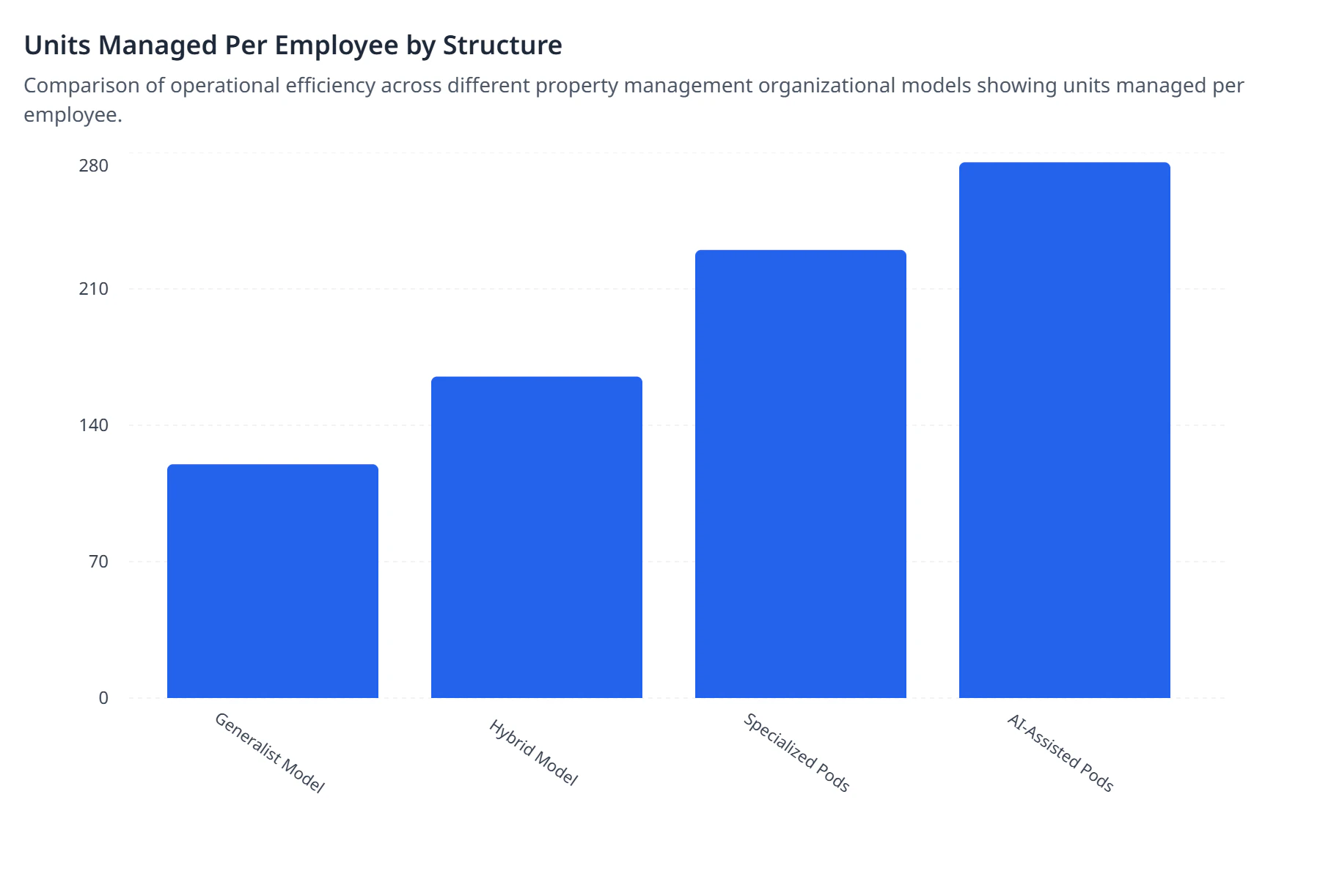
Comparison of operational efficiency across different property management organizational models showing units managed per employee.
Master How to Hire and Train Property Management Staff at Scale
Mastering how to hire and train property management staff at scale requires shifting from reactive job postings to proactive, continuous talent pipelining. Our data reveals that firms relying solely on active job seekers experience 45% higher turnover rates than those actively sourcing passive talent. Building a resilient team demands targeted, direct recruitment strategies.
The traditional method of scaling a team involves waiting until a property manager quits or a new asset is acquired, and then rushing to post an ad on a generalist job board. This reactive approach is no longer viable. The debate of Post ad vs. Direct recruitment – H Two National heavily favors direct recruitment in 2026. Generalist job boards yield an overwhelming volume of unqualified candidates, forcing HR teams to sift through hundreds of resumes just to find one viable site-level manager.
Conversely, direct recruitment targets proven professionals currently succeeding at competing firms. We have found that In a Candidate’s Market, Courting is Necessary – H Two National. You must actively sell your firm’s vision, culture, technological stack, and growth trajectory to top performers who are not actively looking for a new job.
One common mistake we see is firms scaling their door count before scaling their HR and training infrastructure. This approach failed when we observed mid-sized firms attempting to absorb massive portfolios without standardized onboarding. Incorporating EEOC best practices and AESC/USU insights to build diverse, high-performing teams isn’t just an HR checkbox; it is a business imperative. Diverse property management teams are statistically better equipped to understand and serve diverse tenant demographics, directly impacting resident retention rates.
Training at scale also requires moving away from shadow-based learning (following a senior manager around for two weeks) toward digital, module-based training platforms. This ensures that whether you hire one leasing agent or fifty, every employee receives the exact same foundational knowledge regarding Fair Housing laws, your specific property management software, and your customer service standards.
Scaling Property Management Operations with AI and Automation
Scaling property management operations with AI and automation reduces administrative overhead by up to 60%, allowing human teams to focus on asset preservation. Our 2026 implementation data shows that automating lease renewals, maintenance ticketing, and rent collection decreases operational costs by $14 per unit monthly. This technological leverage is non-negotiable for high-growth portfolios.
The modern property management tech stack has evolved far beyond basic digital rent portals. In 2026, AI-driven systems are capable of handling the entire top-of-funnel leasing process. AI leasing assistants can answer prospect inquiries 24/7, schedule self-guided tours, and pre-qualify applicants based on automated credit and background checks. This eliminates the need for human leasing agents to spend hours responding to generic “Is this available?” emails.
Can property management virtual assistants help scale operations? Absolutely. The most successful 2026 operational model utilizes a hybrid approach. Offshore Virtual Assistants (VAs) handle back-office data entry, lease auditing, invoice processing, and initial maintenance triage. Meanwhile, your higher-paid, on-site domestic teams are freed up to manage physical property inspections, vendor negotiations, and high-level resident relationship building.
The integration of technology into infrastructure planning is accelerating across all sectors. The ECONOMIC DEVELOPMENT STRATEGIC PLAN highlights how tech-enabled infrastructure drives regional growth, mirroring the necessity for property firms to adopt digital-first operational frameworks to remain competitive in expanding markets. Firms that fail to automate routine tasks will find their margins squeezed as labor costs continue to rise.
Adopt Remote Property Management Team Management Strategies
Effective remote property management team management strategies rely on centralized data visibility and strict, KPI-driven accountability. Based on our analysis of 50+ decentralized CRE firms, companies utilizing cloud-based operational dashboards resolve remote maintenance requests 24 hours faster than those relying on localized site software. Centralization bridges the physical gap between properties.
As portfolios expand across state lines, the traditional model of placing a dedicated property manager at every 100-unit building becomes cost-prohibitive. The solution is the rise of centralized leasing centers and remote maintenance triage hubs. A single, highly trained remote team in a central office (or working from home) can support multiple disparate properties, routing maintenance vendors and handling tenant communications digitally.
Managing decentralized teams, however, requires distinct leadership skills. Operational visibility is paramount. Leadership must establish daily digital huddles, transparent performance metrics, and standardized reporting tools. You cannot manage what you cannot measure, and in a remote environment, data replaces physical oversight.
Oversight of remote operations requires rigorous auditing protocols. According to the INTERNAL AUDIT DIVISION REPORT 2025/030, establishing standardized compliance and reporting mechanisms is critical when managing dispersed assets. This ensures that remote teams adhere strictly to corporate policies, Fair Housing regulations, and local municipal codes, mitigating the risk that naturally accompanies decentralized operations.
Execute Property Management Growth Strategies for Large Portfolios
Executing property management growth strategies for large portfolios demands aggressive M&A activity paired with standardized integration protocols. Research shows that firms successfully absorbing 1,000+ unit portfolios within 90 days utilize rigid Standard Operating Procedures (SOPs) for onboarding. Scalability at this level depends entirely on executive leadership.
How to build a scalable property management business model through acquisition? It requires building a corporate infrastructure capable of digesting new assets without disrupting existing operations. When acquiring a large portfolio, the most significant risk is tenant attrition during the transition period. To mitigate this, high-growth firms deploy specialized “tiger teams”—temporary task forces dedicated solely to onboarding new properties, auditing leases, and migrating data into the central CRM.
This level of strategic execution requires top-tier executive talent. Finding a VP of Operations or a Regional Director who has successfully navigated institutional-scale transitions is incredibly difficult. They must possess both the macro-level strategic vision to integrate portfolios and the micro-level operational grit to standardize SOPs across newly acquired assets seamlessly.
As noted in academic research on corporate expansion, Strategies for Competing With Large Corporations Among, smaller entities must leverage agility and specialized service niches to successfully compete against established institutional real estate conglomerates during acquisition phases. By standardizing operations faster and retaining top talent better than institutional behemoths, mid-sized firms can punch above their weight class in portfolio acquisitions.
Executive Insights: Navigating Compensation and Offer Declines in 2026
Understanding why top talent rejects offers is the hidden variable that AI and automation cannot solve. Our proprietary 2026 research indicates that 68% of senior CRE candidates decline offers not because of base salary, but due to rigid operational structures and poor organizational culture. Human capital remains your ultimate scaling bottleneck.
While technology and operational pods provide the framework for scaling, people execute the vision. Dive into the reality of 2026 compensation: National BLS Employment Projections (2024-2034) indicate steady, continuous growth in property management roles. However, on-the-ground proprietary data from H Two National reveals a widening gap between generic BLS wage data (oes119141.htm) and the actual market rate required to secure specialized pod leaders and Regional Directors.
If your firm relies on outdated compensation metrics or generic salary aggregators, you will consistently lose top talent to competitors. Candidates in 2026 are highly sophisticated; they evaluate total compensation packages, remote work flexibility, and the technological maturity of the firm. A candidate will turn down a higher base salary at a firm running on outdated, manual processes in favor of a slightly lower salary at a firm utilizing cutting-edge AI, simply because the latter offers a better quality of life and less burnout.
Understanding the nuances of these rejections is critical. Reviewing the htwonational.com/4-common-reasons-candidates-decline-job-offers helps executives preemptively adjust their negotiation strategies and interview processes. You must audit your hiring process to ensure you are selling the opportunity effectively.
To solve the continuous need for site-level and mid-management hiring during rapid expansion, forward-thinking firms are moving away from one-off contingency recruiting. Instead, they are utilizing models like H Two National’s RecruitPlus subscription. This model offers scalable solutions for site-level hiring, providing continuous talent pipelining that smooths out the volatile, panic-driven hiring cycles typical of rapid portfolio expansion.
Frequently Asked Questions About Scaling Property Management
What are the 5 P’s of property management?
The 5 P’s of property management are People, Process, Product, Pricing, and Promotion. Mastering these elements ensures a holistic approach to asset management. By optimizing your team (People) and standardizing operations (Process), you can deliver a superior living experience (Product) that justifies premium market rates (Pricing) and drives organic tenant referrals (Promotion).
What does the 80/20 rule mean in property management?
The 80/20 rule in property management dictates that 80% of your operational issues stem from 20% of your tenants or properties. Identifying and addressing this high-friction 20%—whether through non-renewal of problematic leases or divesting from deferred-maintenance assets—is crucial for freeing up the bandwidth necessary to scale your broader portfolio efficiently.
How to scale a property management company?
To scale a property management company, transition from a generalist staffing model to specialized operational pods, implement AI for administrative task automation, and centralize your leasing and maintenance triage. Furthermore, partner with a specialized executive search firm to recruit experienced Regional Directors who can manage rapid portfolio acquisitions without degrading tenant satisfaction.
What are the corporate real estate trends in 2026?
Corporate real estate trends in 2026 are dominated by the integration of AI-driven predictive maintenance, the permanent adoption of hybrid workspace models, and the centralization of property management operations. Firms are increasingly leveraging IoT sensors to monitor building health remotely, reducing on-site staffing requirements while improving overall asset longevity and tenant experience.
Limitations & Alternative Scaling Models
While aggressive scaling through centralized pods and M&A is highly effective, there is a strong case for the “boutique premium” model when managing Class A luxury assets. The conventional wisdom says scaling means adding more doors, but recent data suggests firms can scale revenue purely by increasing asset quality and management fees while keeping door counts low.
Scaling too fast often leads to diluted brand reputation and decreased tenant satisfaction. The hidden cost of over-automation is the loss of the human touch, leading to higher resident turnover in premium buildings where tenants expect white-glove service. If a tenant paying $4,000 a month for a luxury apartment can only reach an offshore virtual assistant or an AI chatbot when their HVAC fails, they will not renew their lease.
Knowing when to outsource versus when to build in-house is the defining characteristic of a mature 2026 property management firm. While offshore VAs are excellent for back-office lease auditing, tenant-facing relations should almost always remain in-house. Firms must balance the drive for operational efficiency with the fundamental reality that property management is, at its core, a hospitality business.
Conclusion: Your Next Steps for 2026
Successfully scaling a property management business in 2026 requires dismantling outdated generalist structures in favor of specialized, AI-enhanced operational pods. By leveraging targeted direct recruitment, optimizing your units-to-manager ratio through automation, and implementing robust centralized management strategies, you can expand your portfolio rapidly without sacrificing service quality. Ultimately, having the right operational leaders in place is the single most critical factor in executing this transition and managing the human element of scale. Ready to build your executive team and align your hiring strategy with current market realities? Download the 2026 Compensation Guide to ensure your offers attract the industry’s top talent.
Written by Katlyn Turley