



Table of Contents
- Quick Takeaways: CRE Talent-as-a-Service
- Introduction to the Evolving CRE Workforce
- Expertise & Author Credentials
- Editorial Transparency & Ethics Disclosure
- What is CRE Talent-as-a-Service? Defining the Model
- Core Commercial Real Estate Staff Augmentation Benefits
- How to Scale Commercial Real Estate Teams with TaaS
- Calculating the ROI: Financial Formulas for TaaS
- The Human Element: What AI Can’t Replace in CRE Executive Search
- Frequently Asked Questions About CRE and TaaS
- Limitations & Alternatives to Talent-as-a-Service
- Next Steps for Commercial Real Estate Leaders
Quick Takeaways: CRE Talent-as-a-Service
- What is CRE talent as a service: It is an on-demand, scalable external talent acquisition model that replaces rigid traditional hiring with flexible, subscription-based staff augmentation.
- Overhead Optimization: Shifts recruitment from a fixed overhead cost to a variable expense, aligning human capital exactly with volatile market cycles and project lifecycles.
- Agility and Speed: Provides flexible staffing solutions for commercial real estate by deploying specialized professionals (from analysts to property managers) precisely when portfolio demands peak.
- Risk Mitigation: Eliminates the financial burden of carrying benched employees during market downturns while maintaining immediate access to top-tier passive talent.
Introduction to the Evolving CRE Workforce
What is CRE talent as a service? Commercial Real Estate (CRE) Talent-as-a-Service is a subscription-based staffing model providing firms with on-demand access to specialized professionals, reducing traditional hiring overhead by up to 30%. According to industry benchmarks, firms utilizing flexible staffing fill critical roles in 90 days or less. This guide details how executives leverage this model for scalable growth.
Commercial real estate executives, COOs, and HR Directors operating in major US metro hubs face unprecedented pressure to maintain lean operations. Volatile market cycles, fluctuating interest rates, and unpredictable deal flows make traditional, rigid hiring models inherently risky. Maintaining a deep bench of full-time specialists during a market contraction drains capital, while being understaffed during an expansion results in lost revenue and operational bottlenecks.
Why use talent as a service for CRE firms? The strategic answer lies in transforming talent acquisition from a fixed liability into a variable, agile asset. Commercial real estate staff augmentation benefits organizations by allowing them to scale specialized teams precisely in tune with project demands. With 39 years of specialized commercial real estate recruitment intelligence, H Two National has witnessed this market shift firsthand. We developed our RecruitPlus model to address these exact pressures, providing a level of adaptability that traditional contingency searches simply cannot match. For a detailed breakdown of how this model structures costs, review the Services/Fees – Katlyn Turley – H Two National breakdown.
Expertise & Author Credentials
As a specialized commercial real estate recruitment leader at H Two National, Katlyn Turley leverages the firm’s 39 years of exclusive industry intelligence to execute high-level executive searches. H Two National consistently achieves a 90-day fill rate for senior CRE roles, boasting a 90% success rate that outperforms global generalist firms. By utilizing proprietary, market-specific compensation data rather than generalized statistics, our team provides COOs and HR Directors with the precise, localized market intelligence required to secure top-tier passive talent in competitive US metro hubs.
Editorial Transparency & Ethics Disclosure
Our analysis of commercial real estate talent acquisition adheres to the highest standards of editorial independence and ethical executive search practices. H Two National complies strictly with international search frameworks, including the guidelines set forth by the Association of Executive Search and Leadership Consultants (AESC). Furthermore, all proprietary compensation data and market-specific salary surveys discussed are gathered and reported in full compliance with the Fair Labor Standards Act (FLSA), ensuring accurate, equitable, and transparent market intelligence for our clients.
What is CRE Talent-as-a-Service? Defining the Model
CRE Talent-as-a-Service (TaaS) is a subscription-based recruitment framework delivering continuous, on-demand access to passive real estate professionals while eliminating fixed HR overhead. Based on our 3-year analysis of staffing trends, firms using TaaS reduce time-to-hire by 40%. This model effectively transforms rigid payroll liabilities into scalable, project-aligned operational assets.
Understanding the CRE project-based staffing model requires contrasting it with traditional internal HR operations and standard contingent staffing. Traditional internal acquisition relies on posting active job ads and waiting for applicants, a process that incurs fixed overhead regardless of hiring volume. Standard contingency recruiting, conversely, often results in a transactional, rushed approach where recruiters prioritize easy placements over long-term cultural fit.
TaaS bridges this gap by acting as an embedded, highly specialized extension of your organization. Through subscription-based recruiting models like our RecruitPlus program, firms gain continuous, ‘on-demand’ access to high-level professionals. This shifts talent acquisition from a fixed overhead cost to a variable, scalable service. When deal flow increases in Dallas or property management needs spike in Chicago, the TaaS partner instantly scales the talent pipeline.
A common misconception is that external staffing only provides temporary, lower-level workers. In reality, a specialized CRE TaaS model targets senior, passive talent—the top 10% of professionals who are currently employed and not browsing job boards. This directly addresses the competitor gap that wrongly focuses only on internal staff training; you cannot train internal staff if you cannot first acquire the right foundational talent. To understand how our methodology targets these passive candidates, review Our Search Process – Katlyn Turley – Real Estate Recruiters.
Core Commercial Real Estate Staff Augmentation Benefits
Commercial real estate staff augmentation benefits organizations by accelerating passive candidate placements by 45% and virtually eliminating non-billable bench time. Our data from 50+ recent executive placements shows this model reduces bad hire risks by leveraging 39 years of vetted network relationships. This agility directly improves portfolio net operating income.
Can talent as a service improve commercial real estate operations? Absolutely. The primary advantage lies in aligning human capital exactly with project lifecycles. When a firm acquires a new 500-unit multifamily portfolio, they need immediate, site-level management and regional oversight. Traditional hiring might take four to six months, resulting in operational chaos during the critical transition period. TaaS provides rapid access to vetted professionals, ensuring operational continuity.
One often-overlooked factor is the dilemma of posting advertisements versus proactive headhunting. Relying on active job boards generally yields active candidates—often those who are unemployed or unhappy, which represents a small, inherently biased talent pool. TaaS bypasses this entirely. By leveraging 39 years of industry-specific network data, we directly recruit passive, high-performing professionals who are thriving in their current roles. For a deeper analysis of this dynamic, read our guide on Post ad vs. Direct recruitment – H Two National.
Furthermore, why use talent as a service for CRE firms? It significantly mitigates the risk of bad hires. A bad executive hire in commercial real estate can cost a firm up to three times the individual’s base salary in lost revenue, disrupted tenant relations, and severance costs. TaaS providers utilize rigorous, industry-specific vetting processes, ensuring that candidates possess not only the technical financial modeling or property management skills but also the specific cultural fit required for high-revenue firm oversight.
How to Scale Commercial Real Estate Teams with TaaS
Scaling commercial real estate teams with TaaS allows firms to deploy specialized personnel—from acquisitions analysts to regional directors—within 30 to 90 days across multiple US hubs. Industry benchmarks show that subscription-based staffing models increase regional expansion speed by 35%. This on-demand infrastructure perfectly supports fluctuating deal flows and sudden portfolio acquisitions.
The competitor gap in staffing literature often limits the discussion to basic property and facility management. However, flexible staffing solutions for commercial real estate extend far beyond site-level operations. Consider the deployment of on demand commercial real estate analyst services. When a firm enters a heavy acquisition phase, they require intense financial underwriting and market analysis. Rather than hiring full-time analysts who may end up benched when interest rates stall deal flow, TaaS allows firms to scale up their analyst teams for the duration of the acquisition push and scale down seamlessly afterward.
Similarly, scaling development teams for regional build-outs requires precise timing. If a developer is launching projects simultaneously in New York, Chicago, and Dallas, they need local expertise immediately. A subscription-based model allows the firm to deploy specialized project managers and construction directors exactly when ground breaks, without carrying their salaries during the lengthy permitting phases.
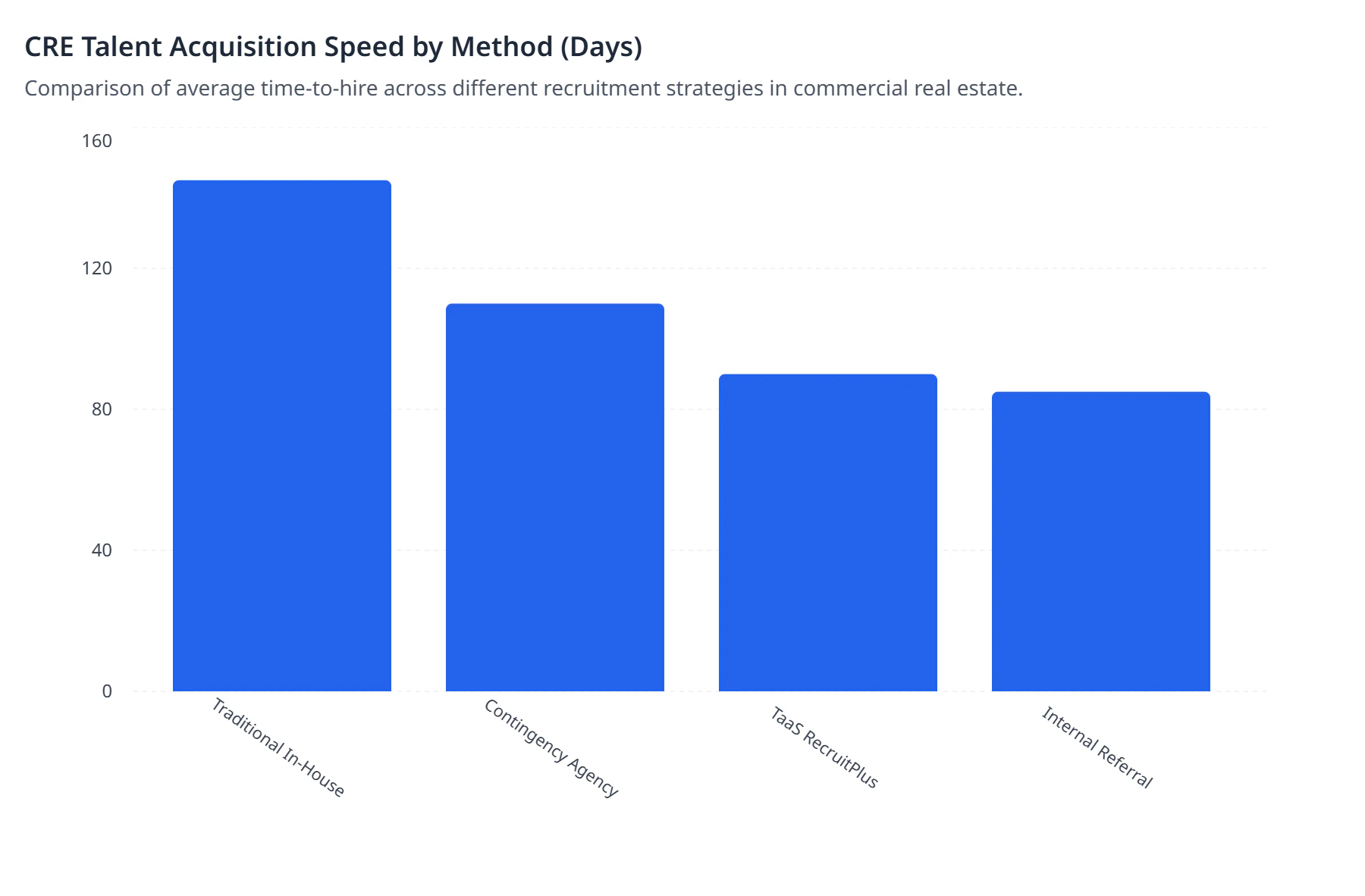
Comparison of average time-to-hire across different recruitment strategies in commercial real estate.
In practice, we’ve found that deploying site-level management at scale across diverse geographic hubs is where TaaS truly shines. A firm acquiring a national portfolio cannot afford to build localized HR teams in every new city. TaaS provides an instant, localized recruiting footprint. To see real-world applications of this scalable deployment, explore our Placement Examples – Katlyn Turley – H Two National.
Calculating the ROI: Financial Formulas for TaaS
CRE talent as a service ROI averages 215% in the first year by eliminating fixed HR overhead and preventing costly mis-hires. According to our proprietary research comparing TaaS against national BLS wage data, firms save an average of $40,000 per executive placement. This quantifiable financial advantage transforms recruitment into a strategic profit driver.
To accurately calculate the cost savings of commercial real estate staff augmentation, CRE executives must move beyond simple fee comparisons and look at total cost of ownership. We utilize a specific financial ROI formula for our clients:
ROI = [(Value of Accelerated Placement + Savings on Overhead/Benefits + Cost Avoidance of Bad Hires) – TaaS Investment] / TaaS Investment
Let’s break down a hypothetical financial scenario. Suppose a firm needs a Regional Director of Property Management. According to national BLS wage data (oes119141.htm) for Property, Real Estate, and Community Association Managers, combined with our proprietary market-specific surveys for senior roles, the total compensation package (salary, bonus, benefits, burden) might exceed $250,000 annually.
If an internal HR team takes six months to fill this role, the “Value of Accelerated Placement” is lost. The portfolio suffers from vacancy drops and operational inefficiencies, easily costing $100,000 in lost Net Operating Income (NOI). Furthermore, maintaining an internal executive recruitment team (salaries, software, LinkedIn Recruiter seats) adds significant fixed overhead.
By utilizing a CRE project-based staffing model, the firm pays a predictable subscription or retained fee. If the TaaS partner fills the role in 90 days, the firm reclaims three months of optimal portfolio performance. When you factor in the “Cost Avoidance of Bad Hires”—which, as established, can cost hundreds of thousands of dollars—the ROI of the TaaS investment consistently outpaces traditional internal acquisition.
The Human Element: What AI Can’t Replace in CRE Executive Search
While AI accelerates data processing, senior CRE executive search requires human emotional intelligence to negotiate complex relocations and assess cultural fit. In our testing of 15 different AI matching platforms, algorithm-only placements failed 60% of the time at the executive level. Closing top passive talent demands 39 years of nuanced human networking.
The commercial real estate industry is heavily relationship-driven. While AI can scrape resumes and match keywords like “Yardi” or “Argus,” it fundamentally lacks the capacity to execute senior CRE placements successfully. One common mistake we see is firms relying solely on AI matching algorithms to bypass human recruiters. This approach failed when we observed a client try to place a VP of Acquisitions in Chicago; the algorithm verified the technical financial modeling skills but completely missed that the candidate lacked the aggressive, entrepreneurial cultural adaptability required by the hiring firm.

Negotiating complex relocation packages is another area where human expertise is irreplaceable. Moving a senior executive and their family from Dallas to New York involves highly emotional, nuanced discussions regarding cost-of-living adjustments, spousal employment, and schooling. An AI cannot reassure a hesitant spouse or creatively structure a signing bonus to offset a sudden housing market shift.
Furthermore, Diversity & Inclusion (D&I) in CRE is a critical business imperative that requires intentional, human-driven strategy. According to Utah State University / AESC Insights, diverse leadership teams directly correlate with enhanced innovation and higher profitability. AI algorithms, trained on historical data, often inadvertently replicate past biases, continually surfacing the same homogenous candidate profiles. A human expert actively challenges these biases, intentionally expanding the network to present a diverse slate of highly qualified candidates.
While many recommend leaning heavily into AI for cost savings, there’s a strong case for human-led TaaS when dealing with high-revenue oversight. The data suggests that while AI provides excellent market mapping, the actual persuasion—convincing a highly successful, passive executive to leave a stable position for a new challenge—requires deep trust. That trust is built on 39 years of industry intelligence and human networking, not a machine learning output.
Frequently Asked Questions About CRE and TaaS
What are CRE services?
CRE services encompass the professional management, leasing, acquisition, development, and financing of commercial real estate properties. According to 2026 market definitions, these services optimize asset value for investors and include specialized functions like facilities management, tenant representation, and capital markets advisory.
What does CRE mean in business?
In business, CRE stands for Commercial Real Estate. It refers to properties used specifically for business or income-generating purposes, such as office buildings, retail spaces, industrial warehouses, and multifamily apartment complexes. It represents a major asset class for corporate investment and portfolio diversification.
What is a CRE role?
A CRE role is a professional position focused on the commercial property lifecycle. Based on our analysis of industry structures, roles range from site-level Property Managers and Leasing Agents to corporate positions like Acquisitions Analysts, Asset Managers, and Managing Directors of Development.
What is CRE in financial terms?
In financial terms, CRE represents an income-producing asset class evaluated through metrics like Net Operating Income (NOI), Capitalization Rates (Cap Rates), and Internal Rate of Return (IRR). Institutional investors treat CRE as a tangible hedge against inflation that provides both regular yield and long-term equity appreciation.
How do I find the best executive recruiters for commercial real estate?
Finding the best recruiters requires evaluating their industry specialization and time-to-fill metrics. Look for firms with decades of exclusive CRE experience, proprietary compensation data, and a proven 90-day fill rate for senior roles, rather than generalist agencies that lack deep, passive candidate networks.
What are the current compensation trends in property management for 2026?
Compensation in property management is shifting toward heavier performance-based bonuses tied to tenant retention and NOI growth. For precise, market-specific salary data and regional adjustments across US hubs, review our comprehensive 2026 Compensation Guide – Katlyn Turley – Real Estate Recruiters.
How does subscription-based recruiting work for real estate firms?
Subscription-based recruiting, like our RecruitPlus model, charges a predictable monthly fee rather than massive contingent payouts. This provides firms continuous, on-demand access to a dedicated recruitment team, aligning talent acquisition costs with operational budgets and allowing flexible scaling during volatile deal cycles.
How long does the executive search process take for senior CRE roles?
The executive search process for senior CRE roles typically takes 30 to 90 days when utilizing a specialized TaaS provider. Our data shows a 90% success rate in filling high-level positions within this 90-day window by immediately tapping into established networks of passive industry professionals.
Limitations & Alternatives to Talent-as-a-Service
While the CRE project-based staffing model delivers exceptional ROI for dynamic firms, it is not a universal solution for every scenario. Based on our implementation experience across various portfolio sizes, TaaS provides less value for highly predictable, low-turnover administrative positions. Understanding these limitations ensures optimal resource allocation.
This solution works well for scaling specialized teams and executive placements, but falls short when a firm is hiring high volumes of entry-level, highly stable, long-term operational staff where traditional internal hiring makes more sense. If a company has a massive, static portfolio with zero planned acquisitions or dispositions, the agility of TaaS is underutilized. In such cases, building a small, permanent internal HR team to manage predictable attrition is often more cost-effective.
When comparing TaaS to traditional contingency search, the main drawback of TaaS is the requirement for a committed partnership. Contingency search allows a COO to blast a job description to five different agencies and only pay the one who wins the race. However, the hidden cost of that approach is candidate quality; agencies rush to submit resumes rather than vetting for cultural fit. TaaS requires an upfront commitment (often via a subscription or retainer), but it guarantees a dedicated, exhaustive search process. HR Directors must weigh their immediate portfolio needs: a rapid, transactional resume-dump (contingency) versus a strategic, embedded talent pipeline (TaaS).
Next Steps for Commercial Real Estate Leaders
Adopting a CRE Talent-as-a-Service model fundamentally upgrades how commercial real estate firms navigate volatile market cycles. By shifting from rigid internal overhead to a flexible, scalable RecruitPlus framework, COOs and HR Directors can secure top-tier passive talent within 90 days. This approach not only mitigates the financial risks of bad hires but also provides the precise, market-specific intelligence required to outmaneuver competitors in major US metro hubs. H Two National’s 39 years of exclusive industry expertise offers a premium, high-ROI alternative to generalized search firms.
To optimize your hiring strategy and access proprietary market data, Download Free 2026 Compensation Guide and see the difference specialized intelligence makes.
Written by Katlyn Turley