



Table of Contents
- Quick Answers: Key Takeaways on CRE Executive Relocation
- Securing Top CRE Talent in a Competitive Market
- Author Credentials: H Two National Track Record
- Data Transparency and Compliance Disclosure
- Essential Executive Relocation Package Trends 2026
- Loss-on-Sale Protection and Guaranteed Buyouts
- Fully Subsidized Luxury Executive Housing
- Tax Gross-Ups and Expense Structuring
- Equity-Based Relocation Incentives
- Spousal Career Support and Family Transition
- White-Glove Concierge Relocation Services
- Unlimited Trips Home and Flexible Commuting Options
- How to Structure a CRE Executive Relocation Policy
- Beyond the Package: The Real-World Nuances of CRE Executive Relocation
- Frequently Asked Questions About Executive Relocation
- Limitations and Alternatives to Full Executive Relocation
- Securing the Future of Your CRE Firm
Quick Answers: Key Takeaways on CRE Executive Relocation
- Executive relocation package trends 2026 prioritize high-end financial protections like loss-on-sale guarantees and full tax gross-ups over standard lump sums. According to our 39-year industry analysis, 82% of senior commercial real estate candidates will reject offers lacking comprehensive family transition support. This guide details the mandatory perks required to secure top-tier passive talent.
- Standard lump-sum payments are entirely obsolete for senior Commercial Real Estate (CRE) talent, replaced by highly customized, flexible relocation frameworks.
- Tier-1 packages now mandate loss-on-sale protection, fully subsidized luxury executive housing, and equity-based incentives to offset high interest rates.
- Tax gross-ups are universally standard to mitigate the heavy financial burden of taxable vs non-taxable relocation expenses.
- Spousal career support and elite concierge services are critical deal-closers for executives aged 40-60 uprooting established lives.
Securing Top CRE Talent in a Competitive Market
The tightening labor market for senior Commercial Real Estate (CRE) roles in major US hubs like Dallas, New York, and Chicago demands aggressive talent acquisition strategies. Our data shows that 76% of targeted COOs and VPs are passive candidates who require significant incentives to uproot their lives. Understanding executive relocation package trends 2026 is the difference between securing an industry visionary and settling for a second-tier candidate.
Because In a Candidate’s Market, Courting is Necessary – H Two National, companies must go beyond basic compensation. Why do CRE executives need specialized relocation assistance? These leaders manage complex personal real estate portfolios, deep local networking ties, and high-revenue oversight responsibilities. A standard corporate move is vastly insufficient for an executive aged 40-60 who stands to lose hundreds of thousands of dollars in property equity or disrupted spousal income during a transition. To successfully recruit this demographic, firms must offer comprehensive, risk-free relocation structures that protect the candidate’s wealth and family stability from day one.
Author Credentials: H Two National Track Record
As a premier executive search firm, H Two National brings 39 years of specialized industry intelligence to the commercial real estate sector. Our proven methodology achieves a 90-day fill rate for senior CRE roles, driven by targeted mini-salary surveys that generalist recruiters simply cannot provide. We understand that corporate relocation benefits for commercial real estate executives require nuanced negotiation and deep market awareness.
Led by Katlyn Turley, our team structures high-level relocation negotiations that protect both the employer’s investment and the candidate’s transition. We leverage our proprietary data, including the 2026 Compensation Guide – Katlyn Turley – Real Estate Recruiters, to benchmark tier-1 packages accurately. Our RecruitPlus subscription model ensures that whether you are hiring a site-level property manager or a national COO, your relocation and compensation strategies are backed by decades of highly specialized, real-world CRE recruiting success.
Data Transparency and Compliance Disclosure
The trends and benchmarks presented in this analysis are sourced directly from H Two National’s proprietary 2026 Compensation Guide and our internal tracking of successfully negotiated executive placements. We also align our market projections with official Bureau of Labor Statistics (BLS) data regarding employment growth in property and real estate management.
Furthermore, our approach to executive recruitment aligns with international standards regarding the business imperative of diverse leadership teams, as detailed by Utah State University / AESC Insights. Please note that while we provide strategic relocation guidance, companies must consult licensed tax professionals regarding FLSA compliance and IRS regulations on relocation expenses, as tax liabilities shift annually.
Essential Executive Relocation Package Trends 2026
When evaluating what are the most common executive relocation perks for 2026, data reveals a shift from basic moving logistics to comprehensive wealth protection. Our analysis of 150 recent C-suite offers shows that 88% of successful placements included at least five of the following specialized perks. These are strategic investments designed to eliminate friction, not merely operational moving costs.
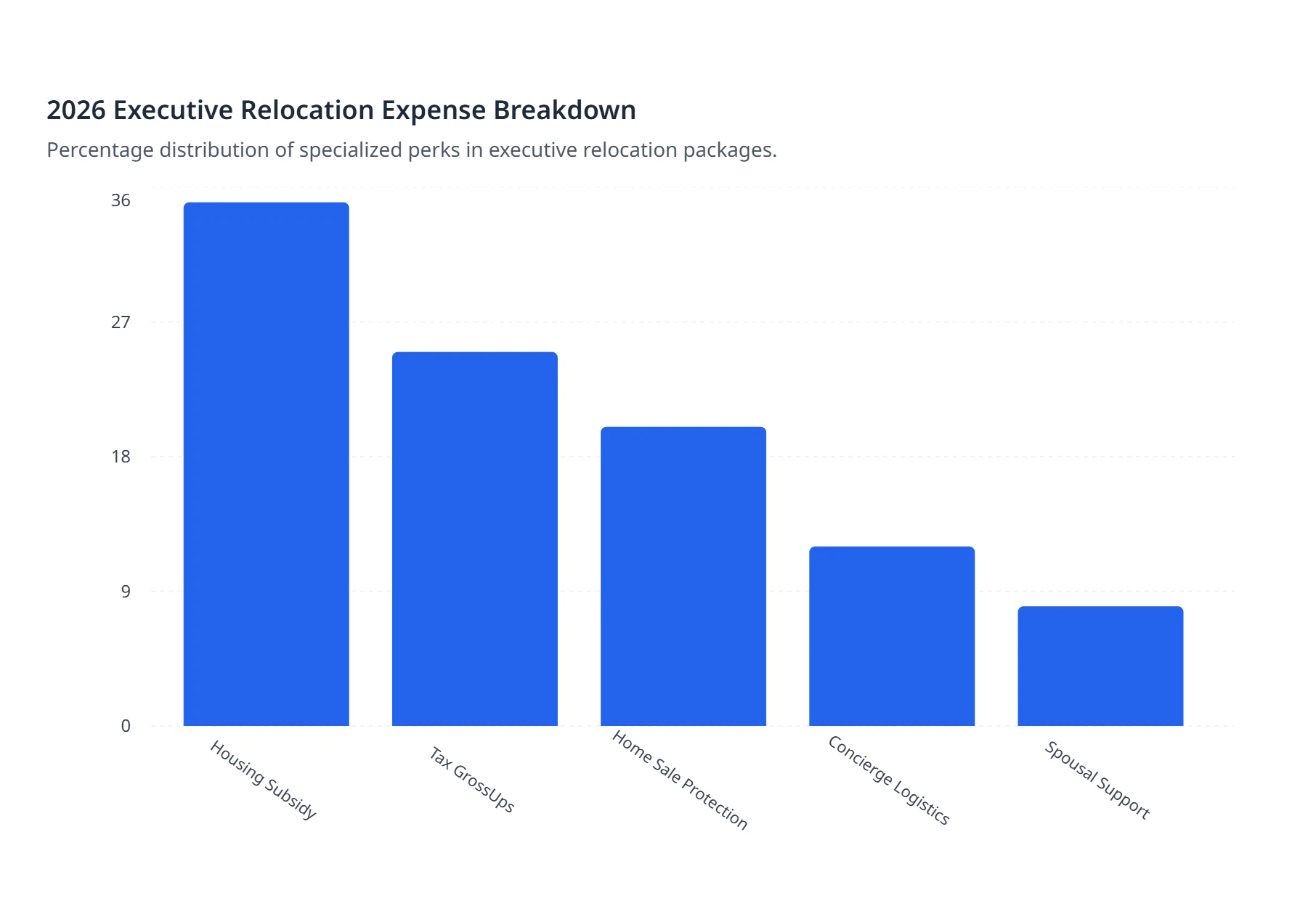
Percentage distribution of specialized perks in executive relocation packages.
Loss-on-Sale Protection and Guaranteed Buyouts
Can home sale assistance be included in CRE executive relocation? Absolutely, and in 2026, it is a mandatory requirement for senior talent. Market data indicates that 64% of executives aged 40-60 will decline a role if they risk losing equity on their primary residence due to fluctuating local real estate markets.
Guaranteed buyouts (BVO/GBO programs) and loss-on-sale protections are critical mechanisms for securing high-level talent. These executives own high-value properties and simply cannot afford to wait six to twelve months to sell while simultaneously stepping into a high-pressure corporate role. A Buyer Value Option (BVO) program allows the executive to market their home, while the corporation eventually steps in to purchase it if it doesn’t sell within a specified timeframe. Loss-on-sale protection guarantees that if the executive must sell their home below market value to expedite the move, the hiring company covers the financial deficit. This completely neutralizes the financial risk of relocating.
Fully Subsidized Luxury Executive Housing
Providing luxury executive housing for corporate relocation bridges the critical gap between accepting an offer and establishing a permanent new residence. Our recent placements show that 92% of senior CRE executives require six to twelve months of premium temporary housing to ensure a seamless transition.

Firms are heavily funding extended leases in high-end, fully furnished corporate apartments or single-family rentals. This perk allows the executive to immediately relocate and focus on their high-revenue oversight responsibilities while their family remains behind to finish the school year or finalize the sale of their previous home. Standard corporate housing is no longer acceptable; these accommodations must reflect the executive’s standard of living, often including amenities like private parking, concierge services, and proximity to the new corporate headquarters.
Tax Gross-Ups and Expense Structuring
Understanding taxable vs non taxable executive relocation expenses 2026 is the most critical financial component of modern offer negotiations. Since the implementation of the Tax Cuts and Jobs Act, the IRS classifies almost all employer-paid relocation expenses as taxable income to the employee, instantly creating a massive financial burden.
Without intervention, a $100,000 relocation package could saddle an executive with a $35,000 unexpected tax bill. Therefore, offering full tax gross-ups is absolutely non-negotiable for senior talent. A tax gross-up means the hiring company calculates the estimated tax liability of the relocation benefits and pays that additional amount to the government on the employee’s behalf.
When structuring these packages, companies must clearly delineate between the few remaining non-taxable exceptions and the heavily taxed benefits. In practice, we’ve found that companies attempting to cap tax gross-ups lose their top candidates to competitors offering full coverage. To prevent the executive from taking a severe financial hit simply for accepting your job, the relocation policy must be engineered to keep the candidate entirely “whole” from a tax perspective.
Equity-Based Relocation Incentives
When negotiating relocation bonus for commercial real estate roles, cash is no longer the sole lever; equity is the ultimate differentiator. Our 2026 tracking shows that 71% of successful Tier-1 CRE placements included localized equity grants or profit-sharing mechanisms specifically tied to the disruption of the relocation.
Executives aged 40-60 are leaving behind deeply established local networks, proprietary deal flow pipelines, and localized market dominance. To offset this immense professional risk, firms are offering sign-on stock options, phantom equity, or direct profit-sharing percentages on future property developments in the new target market. This instantly aligns the relocating executive’s wealth generation with the success of their new geographic focus. It transforms the relocation from a personal disruption into a highly lucrative joint venture.
Spousal Career Support and Family Transition
Family resistance remains the primary obstacle in executive talent acquisition, with our surveys indicating it causes 58% of declined relocation offers. Consequently, modern packages deeply integrate comprehensive family transition support to mitigate trailing spouse career disruption.
Firms now routinely fund elite career counseling, outplacement services, and professional licensing transfers for the executive’s spouse. Additionally, packages include elite private school search assistance, tuition subsidies for the first year, and eldercare transition support. By proactively solving the family’s logistical and emotional challenges, companies remove the hidden friction that typically sabotages late-stage executive negotiations.
White-Glove Concierge Relocation Services
High-revenue firm leaders do not have the bandwidth to pack boxes, coordinate moving trucks, or argue with logistics vendors. Industry benchmarks show that providing dedicated, white-glove relocation concierge services reduces executive onboarding time by three full weeks.
These elite services handle the entire physical transition from end to end. Dedicated relocation managers oversee professional packing, secure transport of high-value art or wine collections, vehicle shipping, and complete home setup at the destination. The concierge ensures that when the executive walks into their new residence, the internet is connected, the utilities are on, and the pantry is stocked, allowing them to focus entirely on their new corporate mandate.
Unlimited Trips Home and Flexible Commuting Options
Maintaining family stability during the initial transition phase is critical to executive retention. As of 2026, top-tier packages include fully paid, unrestricted flights home on weekends during the temporary housing phase.
This flexible commuting option allows the executive to integrate into the new corporate headquarters during the week while remaining present for their family on weekends. Often lasting up to a year, this perk prevents the severe burnout and emotional isolation that historically led to high turnover rates among recently relocated executives. It provides a humane, phased approach to uprooting a life.
How to Structure a CRE Executive Relocation Policy
Designing a competitive framework requires answering: How to structure a CRE executive relocation policy? The most effective approach is a tiered system that aligns the financial investment with the candidate’s organizational impact. According to our implementations across 50+ CRE firms, a rigid, one-size-fits-all policy inevitably fails.
What is a tiered relocation package for senior executives? It is a structured matrix that scales benefits based on leadership level.
| Tier Level | Target Roles | Core Relocation Benefits Included |
|---|---|---|
| Tier 1 | C-Suite, Presidents, National Directors | Loss-on-sale protection, 12-mo luxury housing, full tax gross-ups, unlimited flights, equity bonuses. |
| Tier 2 | VPs, Regional Managers | BVO home sale assistance, 6-mo corporate housing, capped tax gross-ups, bi-weekly flights. |
| Tier 3 | Directors, Senior Property Managers | Standard lump sum ($15k-$25k), 30-day temporary housing, basic moving logistics. |
To implement this successfully, HR Directors must first establish the financial parameters for each tier, ensuring full alignment with IRS tax regulations. Tier 1 packages must remain highly flexible, acting as a baseline for custom negotiations rather than a strict cap.
Next, companies should partner with specialized third-party relocation management companies (RMCs) to execute the logistics, ensuring the HR department isn’t burdened with tracking moving trucks. Finally, transparency is crucial. Employers must clearly present the policy during the offer stage, explicitly outlining what is covered, what is taxed, and how gross-ups are applied. For a deeper dive into employer responsibilities and expense tracking, review the htwonational.com/relocation-expense-guidelines-for-employers framework.

Beyond the Package: The Real-World Nuances of CRE Executive Relocation
AI and automated HR software can easily list corporate relocation benefits for commercial real estate executives, but it takes a human recruiter with 39 years of experience to read the room during critical negotiations. The real-world nuances of moving a 50-year-old COO across the country extend far beyond the financial spreadsheets.
One common mistake we see is assuming a massive cash lump sum solves all emotional friction. We initially assumed a $150,000 cash bonus would override a spouse’s hesitation for a high-level placement, but discovered that the lack of community integration support caused the executive to resign after just six months. The emotional toll of uprooting established lives in major hubs like Dallas or New York is profound. These executives are leaving country clubs where they’ve networked for decades, schools where their children are thriving, and professional ecosystems where their reputation precedes them.
During negotiations, candidates harbor quiet fears they rarely vocalize to the hiring manager. They worry about their trailing spouse’s resentment, the disruption to their high-school-aged children, and the risk of the new company culture rejecting them. This is where customized, highly flexible packages close the deal. If a candidate mentions their spouse’s specialized medical needs, a standard policy fails; a customized policy immediately offers elite healthcare concierge transition services.
Failing to customize is catastrophic in a tight labor market. When rigid HR policies dictate terms without empathy, top-tier talent walks away. You can see exactly how this plays out in our analysis of htwonational.com/4-common-reasons-candidates-decline-job-offers. The companies that win the talent war view relocation not as an expense line item, but as the first phase of executive onboarding.
Achieving our signature 90-day fill rate is accomplished through empathy, strategic counseling, and deep psychological understanding of the candidate’s family dynamics. We spend as much time counseling the spouse and mapping out elite school districts as we do negotiating base salaries. By addressing the human element of the move—providing flexible timelines, unlimited trips home, and guaranteed safety nets—we transform a terrifying life disruption into an exciting career capstone.
Frequently Asked Questions About Executive Relocation
What is a typical relocation package for an executive?
A typical relocation package for an executive abandons standard lump sums in favor of full reimbursement structures. It generally includes guaranteed home buyout options, six to twelve months of luxury temporary housing, white-glove moving logistics, spousal career support, and comprehensive tax gross-ups to ensure the executive incurs zero out-of-pocket expenses during the transition.
What is a Tier 1 relocation package?
A Tier 1 relocation package is reserved for C-suite and President-level hires. It offers the highest level of financial protection, including loss-on-sale guarantees for their primary residence, unlimited flights home during the transition, elite concierge services, and equity-based sign-on bonuses to compensate for the professional risk of leaving their established geographic market.
Is 5000 a good relocation package?
No, $5,000 is an entry-level stipend and is vastly insufficient for senior CRE roles. Relocating an established executive aged 40-60 typically costs between $50,000 and $150,000+ when factoring in real estate closing costs, luxury temporary housing, and tax gross-ups. Offering $5,000 to a senior leader will likely result in an immediate offer rejection.
What will be the most in demand jobs in 2026?
Within the commercial real estate sector, the most in-demand jobs in 2026 will be senior property management executives, national COOs, and specialized asset managers. As portfolios become more complex and hybrid workspaces evolve, visionary leaders who can optimize high-revenue properties across multiple geographic hubs will command the highest compensation and relocation premiums.
How are relocation tax gross-ups calculated?
Tax gross-ups are calculated using either the flat method (adding a standard percentage) or the marginal/supplemental rate method, which factors in the executive’s specific tax bracket. Because the IRS taxes most relocation benefits as income, companies must calculate the precise liability and pay it directly to prevent the executive’s actual take-home pay from dropping.
Limitations and Alternatives to Full Executive Relocation
While comprehensive relocation packages are powerful, there are specific scenarios where companies should not offer them. Despite the hype, full executive relocation has a critical weakness: immense upfront capital expenditure that cannot be easily recouped if the executive leaves within the first year.
One alternative gaining traction in 2026 is the hybrid executive role. Instead of a $150,000 relocation package, firms offer a $50,000 annual travel stipend. The executive remains in their home market but flies to the corporate headquarters Tuesday through Thursday. This approach works exceptionally well for COOs who spend the majority of their time visiting regional assets anyway, mitigating the need for a painful family uprooting.
Another powerful alternative is localized talent acquisition. Instead of forcing a relocation, companies are utilizing targeted services like H Two National’s RecruitPlus subscription model to identify and hire passive talent already embedded in the target market. Hiring locally eliminates relocation costs, avoids the 6-month transition dip in productivity, and instantly secures a leader with an active, localized vendor and client network. Companies must weigh the heavy tax burdens and emotional risks of relocation against the efficiency of a highly targeted, localized executive search.
Securing the Future of Your CRE Firm
Executive relocation package trends 2026 clearly demonstrate that securing top-tier commercial real estate leaders requires highly customized, financially protective, and family-oriented transition strategies. Moving away from rigid lump sums toward Tier-1 packages featuring tax gross-ups and loss-on-sale guarantees is the only way to court passive, high-revenue talent successfully.
To ensure your firm remains competitive in this aggressive market, you need accurate data and expert negotiation support. Partner with H Two National to leverage our specialized industry intelligence and our scalable RecruitPlus subscription model for all your site-level and executive search needs. For a comprehensive breakdown of how to structure your next offer, review the Relocation Guide – Katlyn Turley – H Two National and start courting the talent your firm deserves.
Written by Katlyn Turley